What I Think About AI When I Hear About AI: A Slightly Unconventional View

The first occasion that led me to think about artificial intelligence (AI) and machine learning (ML) in the context of libraries came in early 2017, shortly after AlphaGo had beat the world champion of Go at that time, Sedol Lee. But until ChatGPT appeared in Nov 2022, AI and ML have been truly a topic of curiosity for mostly technologists in the library world. It is to be noted that before today’s AI boom in academia and industry, there was the emergence of data science that garnered a lot of attention. This led many academic libraries to develop new services in research data management with a focus on supporting students’ and researchers’ needs in developing data-related programming skills and tools, such as Python and R. But the emergence of data science and ML also led some people in the library world to delve more deeply into AI, AI literacy, and computational literacy, which is closely related to computer science. I was one of them, and I was also working as part of the team that planned and launched the AI Lab at the University of Rhode Island Libraries around 2017~2018. I did experience palpable interests in AI/ML in the local and larger communities, which enlivened our work then. But no one at that time anticipated the public adoption of AI/ML within the 4~5 year timeframe, let alone the meteoric rise of a large language model (LLM) to come.

The Irony in the most popular criticisms of AI

I have to admit that the personal ideas I had at that time about how the general public and academic libraries may adopt and apply AI and ML (and what may show up as the challenges and the opportunities for libraries in that process) turned out to be not at all close to what I came to see after the popularity of ChatGPT and the new boom around AI/ML and LLMs.

Probably the most-frequently voiced complaint about AI/ML that the AI/ML outputs from LLM are not grounded in facts has been what baffled me most throughout the recent mainstream adoption of AI/ML/LLM. This so-called “AI hallucination” has irritated people to such an extent that the new term was coined to refer to that phenomenon. That people would perceive this as the greatest critical flaw and the obvious failure for AI/ML to meet their expectations completely surprised me. And hearing about the deep concerns raised about AI/ML outputs not being repeatable or reproducible (especially from AI scientists) was another highly perplexing moment for me.

The fact that ML outputs are neither fully grounded in facts nor reproducible is not a bug but a feature. It is the very essence of ML, which is data-and-statistics-based (in contrast to symbolic AI that is strictly logic-based). As a matter of fact, it is exactly what has enabled ML to become the poster child of AI, after the long AI winter that followed the pursuit of the logic- and rule-based symbolic AI approach.

To trace its origin, AI was first conceptualized by Alan Turing in his 1950 paper “Computing Machinery and Intelligence.” Turing’s idea was that a machine can be considered intelligent (i.e. as intelligent as another human) if a human conversing with it cannot distinguish if it is a person or not. What is fascinating about Turing’s idea is that it did not try to define what intelligence ‘is.’ It instead proposed what ‘can count as’ intelligence. So, from its very beginning, AI was conceptualized and designed to ‘pass as intelligent’ to humans, not to ‘be’ intelligent on its own. It is important to understand that AI isn’t a concept that can be defined or described independently of human intelligence.

And philosophically speaking, the ultimate tell of (human) intelligence is that regardless of how hard we may try, we can never fully read others’ minds. Ultimately, the other person’s mind is opaque to us, never completely understandable, let alone perfectly predictable. If it were, we would immediately perceive that as not entirely human. To illustrate this point, suppose we have a chat with two beings and make a guess about which one is a person and which one is a machine. The first one gives us a response that we can perfectly predict and is factually correct every time, while the second one always gives a different and even quirky and puzzling response, not always fully corresponding to the matters of fact. After enough time in engaging in conversations with them, which one would we be more inclined to conclude as another human? It would be the second one. We may comment that the second one is odd, or a bit dumb, or both. But we would not pick the first one as a human, because no human being produces a perfectly predictable response. This, of course, is a highly over-simplified scenario. But it is sufficient to show that although we regard rationality as the distinguishing feature of humans, we also know that perfect rationality (and perfect predictability) isn’t a sign of true humanity either. Being less rational does not disqualify us from being a human; being perfectly rational may well.

Seeing how AI has been modeled in light of human intelligence this way, today’s LLMs do deliver exactly what Turing was proposing as ‘artificial intelligence.’ It has succeeded so spectacularly at making people believe that they are interacting with something as intelligent as humans that people are complaining that it is not as smart as (or smarter than) themselves. To be fair, that is not asking for just ‘intelligence.’ It is a request for something different, i.e. “higher intelligence.” How high? It turned out LLM users weren’t satisfied with the college-student level intelligence, for example. The general expectation we saw was such that AI shouldn’t be susceptible to citing inaccurate or non-existing sources, which is a mistake that many college students can make. Many also lament that today’s LLMs cannot do math and physics well enough. Again, LLMs aren’t designed to be good at math and physics. They are designed to pass as good enough.

Isn’t it ironic to find fault with AI for being bad at something that humans are also equally bad at? I am not saying LLMs should not be made more proficient with math and physics. Nor am I saying that being bad at math and physics is a distinguishing characteristic of human intelligence. All I am saying is that today’s AI/ML/LLM tools were built to pass as intelligent enough (to other humans), not to be super-intelligent in the physical properties of the real world. In light of their origin and inner workings, criticizing AI/ML/LLM tools for not being super-intelligent seems quite off the mark.

The role of a community in our ability to assess AI’s performance

When I think about AI when I hear about AI is a neighbor who have heard a lot of things, can talk convincingly and eloquently for a long time, but possesses a mediocre degree of intelligence oneself and can lack logic and reasoning at critical moments. (We all know someone like that in real life, don’t we?) Whether I would consider this neighbor to be brilliant or take their words with a grain of salt would entirely depend on (i) the circumstances of the interaction and (ii) how much I know regarding what this neighbor talks about. My evaluation in this regard would surely be limited and likely erroneous, if I know little about things that this neighbor would talk enthusiastically about at great length. In other matters where I have more knowledge and experience, I would probably be able to assess this neighbor more accurately. Equally importantly, in some circumstances, it may not matter whether what this neighbor says is true, imaginary, and/or possibly deceptive. Under other circumstances, being able to tell that difference can be absolutely critical.

In my opinion, the problem with AI that we are experiencing today isn’t so much about AI per se, nor purely about AI’s performance. The problem is more about how ill-equipped we are in understanding the way AI/ML is designed, effectively assessing its performance, and discerning what matters and what doesn’t, in any given case. And the greatest issue lies in the significant mismatch between this ill-equipped-ness of ours and the very high expectations that we hold AI to.

Furthermore, I think it is worth noting that the online environment, where we get to use AI as an individual consumer and mostly for productivity, makes this problem even more acute. This time, picture a big circle of villagers sitting around a bonfire and talking with one another. You will soon discover that some of those villagers heard a lot of stories; some have sharp analytic skills; some has memorized a lot of facts; some have practical skills but not good at speaking and explaining, and so on. Consider AI as the talker among all these characters. While other villagers chat with this great talker, various signs will soon emerge that would make it more apparent to you that this person is simply good at talking and isn’t actually the smartest or the most knowledgeable. Those signs will in turn help you better assess what this talker character says. All those signs, however, would be unavailable in the online environment, where it is just you and you alone with the AI tool.

If the individualized and isolated online environment, in which each user interacts with AI tools alone, hinders people from more appropriately assessing the AI tool’s performance, what can be done about that? Currently, there is no equivalent of getting all AI users to sit around a bonfire and having them talk to and test AI tools together. But if there were such a way, it would very much help people develop their ability to better assess AI tools’ performance. To come to think of it, wouldn’t libraries be able to organize something to that effect? It could be like a collaborative edit-a-thon where many people gather, try, and evaluate AI tools together, sharing what worked well (or not), what mattered (and didn’t), and why.  

Two things I most worry about today’s AI use

There are two things that I most worry about today’s AI use. One is that most of the AI use is taking place in isolation, lacking a meaningful community discussion. The other is the emerging phenomenon of ‘AI shaming’ and ‘AI stigmatization.’ The use of AI is becoming widespread. The 2024 survey by Digital Education Council showed that the majority (86%) of college students regularly use AI in their studies, with more than half of them using it from daily to at least on a weekly basis. The 2025 survey by Pew Research Center also found that about one-in-ten workers use AI chatbots at work ranging from every day to a few times a week. Despite this rapidly increasing use of AI, there is also clear reluctance displayed among AI users in disclosing or discussing their AI use with others. The 2024 Work Trend Index Annual Report from Microsoft and LinkedIn found that among the 75% of full-time office workers surveyed responded that they use AI at work, over half of them were reluctant to reveal their AI use because it may make them look replaceable. Students and teachers are also reluctant to disclose their AI use since they can face backlash and penalization.

While the worry is certainly understandable, the trend of using AI only privately and neither admitting to its use nor discussing it in public doesn’t help most of us, who need to become better at assessing AI tools’ performance. With each person exploring and using AI tools by themselves, AI users will experience only more challenges in developing a sufficient level of digital skills and literacy necessary to appropriately and thoughtfully using AI tools to their benefit, whether they are students, educators, or workers.

Beyond the potential job loss, other backlash, and possible penalization, the general reluctance to talk about AI use is also connected to many negative associations made about AI from the widely-reported criticisms of AI/ML tools in mass media, ranging from their hallucinations and biases (resulting from the training data), their high consumption of electricity, and the detrimental impact on environmental sustainability to AI algorithms potentially being used to support or deepen existing inequalities.

All these, understandably, led to the emergence of what is called ‘AI shaming.’ ‘AI shaming’ refers to the practice of criticizing or demeaning the use of AI, which commonly manifests as stigmatizing any and all AI uses. Some in this camp (including information professionals and educators) are quite vocal about their opinions about AI. They actively discourage others from exploring AI tools, equating the use of AI to a sign of cheating, dishonesty, and/or laziness. They view any AI use as an inexcusable act of condoning and aiding negative impacts of advancing AI technologies. They stigmatize AI users for being morally irresponsible and justify AI shaming, based upon their belief that AI is inherently unethical and no use of AI should be permitted.

Everyone is entitled to their beliefs, as long as it does not harm others. But I think that AI shaming and AI stigmatization is deeply troubling in the educational and library context, in particular. Librarianship is an endeavor to help people in their pursuit of information- and knowledge-seeking at its core, and the mission of libraries is serving as a reliable institution in providing such help for the public in an unbiased and unprejudiced manner. Libraries’ mission and values are also rooted in respect for everyone’s autonomy and right to pursue knowledge, regardless of where they come from and what beliefs they hold. Everyone comes from different backgrounds, life experiences, and realities, of which others often have little knowledge. It is not a good idea for information professionals to overly prescribe how library patrons should go about looking for information and pursuing knowledge this way and not that way, based upon their own personal beliefs and values, which are likely to be representative of the socioeconomic group that they belong to, more than that of their library patrons. Feeling judged and being subject to shaming or stigmatization would be the last thing that library patrons seeking help would expect from library professionals. Such experiences may well drive library patrons to cope by themselves with difficulties that they run into while using AI tools rather than seeking help from library professionals.

This isn’t saying that we should turn a blind eye to many legitimate issues related to AI. They are real and complex problems and should be properly grappled with. But demeaning people for their use of AI and accusing them of being unethical isn’t a right or productive approach. Furthermore, when library professionals exhibit AI shaming and stigmatization towards library patrons seeking help with AI tools from them, such acts carry the high risk of doing lasting damage to the trust that library patrons place on library professionals.

The ultimate question

In a recent talk about AI that I attended, one question asked was how our society will preserve its intelligence and critical thinking abilities when they no longer seem necessary with AI. What would be the impact of automation and cognitive offloading enabled by AI on us humans? Will we humans become less intelligent and lose the ability to think critically as we rely on AI more and more?

As in most cases, the answer is neither simple nor straightforward. First of all, the impact and result of automation and cognitive offloading would differ significantly depending on what is being automated and offloaded. There are varieties of mental (and physical) labor that are a slog and a chore. They do not lead to our growth in any meaningful way, and we would be glad to rid of them. But some other types of work would be what we would rather continue ourselves, even if they are not fun, because they enable us to expand and fully realize our potential. I think a more challenging and critical question is whether we will be able to discipline ourselves enough to automate and delegate only the former category of tasks to AI, while continuing to engage in the latter category of work, because surely, there will be temptations to slack off and delegate away any and all things unpleasant or challenging if AI seems good enough.

To complicate the matter further, what is seen as a mechanical chore and a mere slog to one person may not be viewed as such to someone else and instead count as a meaningful challenge. Over-generalizing and prescribing what is to be automated and delegated to AI and what is to be retained as the work for humans wouldn’t appeal to or make sense to everyone, since we are all different in our abilities, values, strengths, and weaknesses. If AI can help us, it should be able to help us in a way that caters to our individual needs, instead of forcing us to fit into one mold. AI that does exactly the same thing may have a drastically different meaning and impact on different individuals. We should be open-minded about that possibility and respect each individual’s autonomy, the choices they make for themselves, and the context in which those choices make sense to them, as long as they are reasonable.

Upon receiving that audience question, the speaker opined that whether we (and our society) will be able to retain and preserve our intelligence and critical thinking abilities would depend on whether there will be a sufficient incentive to do so. That is an apt answer, given that the majority of humans in this world live in a market-driven economy, where incentives play a prominent role. What would it look like to provide an incentive for preserving human intelligence and critical thinking abilities?  I am not sure. But surely, that can be done in various ways: utopian, dystopian, or somewhere in between.

Read this on Substack
Posted in AI, Librarianship, Library, Technology | Tagged , , , , , , | Leave a comment

Blockchain: Merits, Issues, and Suggestions for Compelling Use Cases

* This post was also published in ACRL TechConnect.***

Blockchain holds a great potential for both innovation and disruption. The adoption of blockchain also poses certain risks, and those risks will need to be addressed and mitigated before blockchain becomes mainstream. A lot of people have heard of blockchain at this point. But many are unfamiliar with how this new technology exactly works and unsure about under which circumstances or on what conditions it may be useful to libraries.

In this post, I will provide a brief overview of the merits and the issues of blockchain. I will also make some suggestions for compelling use cases of blockchain at the end of this post.

What Blockchain Accomplishes

Blockchain is the technology that underpins a well-known decentralized cryptocurrency, Bitcoin. To simply put, blockchain is a kind of distributed digital ledger on a peer-to-peer (P2P) network, in which records are confirmed and encrypted. Blockchain records and keeps data in the original state in a secure and tamper-proof manner[1] by its technical implementation alone, thereby obviating the need for a third-party authority to guarantee the authenticity of the data. Records in blockchain are stored in multiple ledgers in a distributed network instead of one central location. This prevents a single point of failure and secures records by protecting them from potential damage or loss. Blocks in each blockchain ledger are chained to one another by the mechanism called ‘proof of work’. (For those familiar with a version control system such as Git, a blockchain ledger can be thought of as something similar to a P2P hosted git repository that allows sequential commits only.[2]) This makes records in a block immutable and irreversible, that is, tamper-proof.

In areas where the authenticity and security of records is of paramount importance, such as electronic health records, digital identity authentication/authorization, digital rights management, historic materials that may be contested or challenged due to the vested interests of certain groups, and digital provenance to name a few, blockchain can lead to efficiency, convenience, and cost savings.

For example, with blockchain implemented in banking, one will be able to transfer funds across different countries without going through banks.[3] This can drastically lower the fees involved, and the transaction will take effect much more quickly, if not immediately. Similarly, adopted in real estate transactions, blockchain can make the process of buying and selling a property more straightforward and efficient, saving time and money.[4]

Disruptive Potential of Blockchain

The disruptive potential of blockchain lies in its aforementioned ability to render the role of a third-party authority obsolete, which records and validates transactions and guarantees their authenticity, should a dispute arise. In this respect, blockchain can serve as an alternative trust protocol that decentralizes traditional authorities. Since blockchain achieves this by public key cryptography, however, if one loses one’s own personal key to the blockchain ledger holding one’s financial or real estate asset, for example, then that will result in the permanent loss of such asset. With the third-party authority gone, there will be no institution to step in and remedy the situation.

Issues

This is only some of the issues with blockchain. Other issues include (a) interoperability between different blockchain systems, (b) scalability of blockchain at a global scale with large amount of data, (c) potential security issues such as the 51% attack [5], and (d) huge energy consumption [6] that a blockchain requires to add a block to a ledger. Note that the last issue of energy consumption has both environmental and economic ramifications because it can cancel out the cost savings gained from eliminating a third-party authority and related processes and fees.

Challenges for Wider Adoption

There are growing interests in blockchain among information professionals, but there are also some obstacles to those interests gaining momentum and moving further towards wider trial and adoption. One obstacle is the lack of general understanding about blockchain in a larger audience of information professionals. Due to its original association with bitcoin, many mistake blockchain for cryptocurrency. Another obstacle is technical. The use of blockchain requires setting up and running a node in a blockchain network, such as Ethereum[7], which may be daunting to those who are not tech-savvy. This makes a barrier to entry high to those who are not familiar with command line scripting and yet still want to try out and test how a blockchain functions.

The last and most important obstacle is the lack of compelling use cases for libraries, archives, and museums. To many, blockchain is an interesting new technology. But even many blockchain enthusiasts are skeptical of its practical benefits at this point when all associated costs are considered. Of course, this is not an insurmountable obstacle. The more people get familiar with blockchain, the more ways people will discover to use blockchain in the information profession that are uniquely beneficial for specific purposes.

Suggestions for Compelling Use Cases of Blockchain

In order to determine what may make a compelling use case of blockchain, the information profession would benefit from considering the following.

  1. What kind of data/records (or the series thereof) must be stored and preserved exactly the way they were created.
  2. What kind of information is at great risk to be altered and compromised by changing circumstances.
  3. What type of interactions may need to take place between such data/records and their users.[8]
  4. How much would be a reasonable cost for implementation.

These will help connecting the potential benefits of blockchain with real-world use cases and take the information profession one step closer to its wider testing and adoption. To those further interested in blockchain and libraries, I recommend the recordings from the Library 2.018 online mini-conference, “Blockchain Applied: Impact on the Information Profession,” held back in June. The Blockchain National Forum, which is funded by IMLS and is to take place in San Jose, CA on August 6th, will also be livestreamed.

Notes

[1] For an excellent introduction to blockchain, see “The Great Chain of Being Sure about Things,” The Economist, October 31, 2015, https://www.economist.com/news/briefing/21677228-technology-behind-bitcoin-lets-people-who-do-not-know-or-trust-each-other-build-dependable.

[2] Justin Ramos, “Blockchain: Under the Hood,” ThoughtWorks (blog), August 12, 2016, https://www.thoughtworks.com/insights/blog/blockchain-under-hood.

[3] The World Food Programme, the food-assistance branch of the United Nations, is using blockchain to increase their humanitarian aid to refugees. Blockchain may possibly be used for not only financial transactions but also the identity verification for refugees. Russ Juskalian, “Inside the Jordan Refugee Camp That Runs on Blockchain,” MIT Technology Review, April 12, 2018, https://www.technologyreview.com/s/610806/inside-the-jordan-refugee-camp-that-runs-on-blockchain/.

[4] Joanne Cleaver,”Could Blockchain Technology Transform Homebuying in Cook County and Beyond?,” Chicago Tribune, July 9, 2018, http://www.chicagotribune.com/classified/realestate/ct-re-0715-blockchain-homebuying-20180628-story.html.

[5] “51% Attack,” Investopedia, September 7, 2016, https://www.investopedia.com/terms/1/51-attack.asp.

[6] Sherman Lee, “Bitcoin’s Energy Consumption Can Power An Entire Country — But EOS Is Trying To Fix That,” Forbes, April 19, 2018, https://www.forbes.com/sites/shermanlee/2018/04/19/bitcoins-energy-consumption-can-power-an-entire-country-but-eos-is-trying-to-fix-that/#49ff3aa41bc8.

[7] Osita Chibuike, “How to Setup an Ethereum Node,” The Practical Dev, May 23, 2018, https://dev.to/legobox/how-to-setup-an-ethereum-node-41a7.

[8] The interaction can also be a self-executing program when certain conditions are met in a blockchain ledger. This is called a ‘smart contract.’ See Mike Orcutt, “States That Are Passing Laws to Govern ‘Smart Contracts’ Have No Idea What They Are Doing,” MIT Technology Review, March 29, 2018, https://www.technologyreview.com/s/610718/states-that-are-passing-laws-to-govern-smart-contracts-have-no-idea-what-theyre-doing/.

Posted in Coding, Library, Technology | Tagged , , , | Comments Off on Blockchain: Merits, Issues, and Suggestions for Compelling Use Cases

Taking Diversity to the Next Level

** This post was also published in ACRL TechConnect on Dec. 18, 2017.***

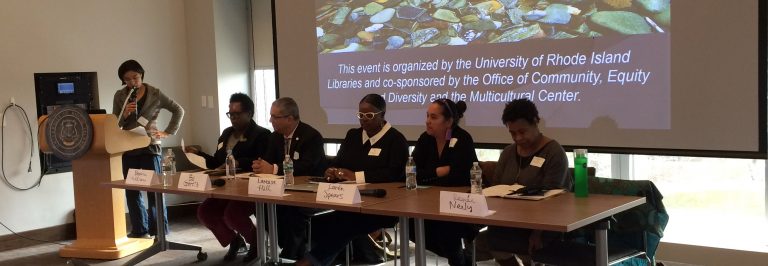
“Building Bridges in a Divisive Climate: Diversity in Libraries, Archives, and Museums,” panel discussion program held at the University of Rhode Island Libraries on Thursday November 30, 2017.

Getting Minorities on Board

I recently moderated a panel discussion program titled “Building Bridges in a Divisive Climate: Diversity in Libraries, Archives, and Museums.”1 Participating in organizing this program was interesting experience. During the whole time, I experienced my perspective constantly shifting back and forth as (i) someone who is a woman of color in the US who experiences and deals with small and large daily acts of discrimination, (ii) an organizer/moderator trying to get as many people as possible to attend and participate, and (iii) a mid-career librarian who is trying to contribute to the group efforts to find a way to move the diversity agenda forward in a positive and inclusive way in my own institution.

In the past, I have participated in multiple diversity-themed programs either as a member of the organizing committee or as an attendee and have been excited to see colleagues organize and run such programs. But when asked to write or speak about diversity myself, I always hesitated and declined. This puzzled me for a long time because I couldn’t quite pinpoint where my own resistance was coming from. I am writing about this now because I think it may shed some light on why it is often difficult to get minorities on board with diversity-related efforts.

A common issue that many organizers experience is that often these diversity programs draw many allies who are already interested in working on the issue of diversity, equity, and inclusion but not necessarily a lot of those who the organizers consider to be the target audience, namely, minorities. What may be the reason? Perhaps I can find a clue for the answer to this question from my own resistance regarding speaking or writing about diversity, preferring rather to be in the audience with a certain distance or as an organizer helping with logistics behind the scene.

To be honest, I always harbored a level of suspicion about how much of the sudden interests in diversity is real and how much of it is simply about being on the next hot trend. Trends come and go, but issues lived through many lives of those who belong to various systematically disadvantaged and marginalized groups are not trends. Although I have been always enthusiastic about participating in diversity-focused programs as attendees and was happy to see diversity, equity, and inclusion discussed in articles and talks, I wasn’t ready to sell out my lived experience as part of a hot trend, a potential fad.

To be clear, I am not saying that any of the diversity-related programs or events were asking speakers or authors to be a sell-out. I am only describing how things felt to me and where my own resistance was originating. I have been and am happy to see diversity discussed even as a one-time fad. Better a fad than no discussion at all.

One may argue that that diversity has been actively discussed for quite some time now. A few years, maybe several, or even more. Some of the prominent efforts to increase diversity in librarianship I know, for example, go as far back as 2007 when Oregon State University Libraries sponsored two scholarships to the Code4Lib conference, one for women and the other for minorities, which have continued from then on as the Code4Lib Diversity Scholarship.2 But if one has lived the entire life as a member of a systematically disadvantaged group either as a woman, a person of color, a person of certain sexual orientation, a person of a certain faith, a person with a certain disability, etc., one knows better than expecting some sudden interests in diversity to change the world we live in and most of the people overnight.

I admit I have been watching the diversity discussion gaining more and more traction in librarianship with growing excitement and concern at the same time. For I felt that all of what is being achieved through so many people’s efforts may get wiped out at any moment. The more momentum it accrues, I worried, the more serious backlash it may come to face. For example, it was openly stated that seeking racial/ethnic diversity is superficial and for appearance’s sake and that those who appear to belong to “Team Diversity” do not work as hard as those in “Team Mainstream.” People make this type of statements in order to create and strengthen a negative association between multiple dimensions of diversity that are all non-normative (such as race/ethnicity, religion, sexual orientation, immigration status, disability) and unfavorable value judgements (such as inferior intellectual capacity or poor work ethic).3 According to this kind of flawed reasoning, a tech company whose entire staff consists of twenty-something white male programmers with a college degree, may well have achieved a high level of diversity because the staff might have potentially (no matter how unlikely) substantial intellectual and personal differences in their thinking, background, and experience, and therefore their clear homogeneity is no real problem. That’s just a matter of trivial “appearance.” The motivation behind this kind of intentional misdirection is to derail current efforts towards expanding diversity, equity, and inclusion by taking people’s attention away from the real issue of systematic marginalization in our society. Of course, the ultimate goal of all diversity efforts should be not the mere inclusion of minorities but enabling them to have agency as equal as the agency those privileged already possess. But note that objections are being raised against mere inclusion. Anti-diversity sentiment is real, and people will try to rationalize it in any way they can.

Then of course, the other source of my inner resistance to speaking or writing about diversity has been the simple fact that thinking about diversity, equity, and inclusion does not take me to a happy place. It reminds me of many bad experiences accumulated over time that I would rather not revisit. This is why I admire those who have spoken and written about their lived experience as a member of a systematically discriminated and marginalized group. Their contribution is a remarkably selfless one.

I don’t have a clear answer to how this reflection on my own resistance against actively speaking or writing about diversity will help future organizers. But clearly, being asked to join many times had an effect since I finally did accept the invitation to moderate a panel and wrote this article. So, if you are serious about getting more minorities – whether in different religions, genders, disabilities, races, etc. – to speak or write on the issue, then invite them and be ready to do it over and over again even if they decline. Don’t expect that they will trust you at the first invitation. Understand that by accepting such an invitation, minorities do risk far more than non-minorities will ever do. The survey I ran for the registrants of the “Building Bridges in a Divisive Climate: Diversity in Libraries, Archives, and Museums” panel discussion program showed several respondents expressing their concern about the backlash at their workplaces that did or may result from participating in diversity efforts as a serious deterrent.4 If we would like to see more minorities participate in diversity efforts, we must create a safe space for everyone and take steps to deal with potential backlash that may ensue afterwards.5

A Gentle Intro or a Deep Dive?

Another issue that many organizers of diversity-focused events, programs, and initiatives struggle with is two conflicting expectations from their audience. On one hand, there are those who are familiar with diversity, equity, and inclusion issues and want to see how institutions and individuals are going to take their initial efforts to the next level. These people often come from organizations that already implemented certain pro-diversity measures such as search advocates for the hiring process.6 and educational programs that familiarize the staff with the topic of diversity, equity, and inclusion.7 On the other hand, there are still many who are not quite sure what diversity, equity, and inclusion exactly mean in a workplace or in their lives. Those people would continue to benefit from a gentle introduction to things such as privilege, microaggression, and unconscious biases.

The feedback surveys collected after the “Building Bridges in a Divisive Climate: Diversity in Libraries, Archives, and Museums” panel discussion program showed these two different expectations. Some people responded that they deeply appreciated the personal stories shared by the panelists, noting that they did not realize how often minorities are marginalized even in one day’s time. Others, however, said they would be like to hear more about actionable items and strategies that can be implemented to further advance the values of diversity, equity, and inclusion that go beyond personal stories. Balancing these two different demands is a hard act for organizers. However, this is a testament to our collective achievement that more and more people are aware of the importance of continuing efforts to improve diversity, equity, and inclusion in libraries, archives, and museums.

I do think that we need to continue to provide a general introduction to diversity-related issues, exposing people to everyday experience of marginalized groups such as micro-invalidation, impostor syndrome, and basic concepts like white privilege, systematic oppression, colonialism, and intersectionality. One of the comments we received via the feedback survey after our diversity panel discussion program was that the program was most relevant in that it made “having colleagues attend with me to hear what I myself have never told them” possible. General programs and events can be an excellent gateway to more open and less guarded discussion.

At the same time, it seems to be high time for us in libraries, museums, and archives to take a deep dive into different realms of diversity, equity, and inclusion as well. Diversity comes in many dimensions such as age, disability, religion, sexual orientation, race/ethnicity, and socioeconomic status. Many of us feel more strongly about one issue than others. We should create opportunities for ourselves to advocate for specific diversity issues that we care most.

The only thing I would emphasize is that one specific dimension of diversity should not be used as an excuse to neglect others. Exploring socioeconomic inequality issues without addressing how they work combined with the systematic oppression of marginalized groups such as Native Americans, women, or immigrants at the same time can be an example of such a case. All dimensions of diversity are closely knitted with one another, and they do not exist independently. For this reason, a deep dive into different realms of diversity, equity, and inclusion must be accompanied by the strong awareness of their intersectionality.8

Recommendations and Resources for Future Organizers

Organizing a diversity-focused program takes a lot of effort. While planning the “Building Bridges in a Divisive Climate: Diversity in Libraries, Archives, and Museums” panel discussion program at the University of Rhode Island Libraries, I worked closely with my library dean, Karim Boughida, who originally came up with the idea of having a panel discussion program at the University of Rhode Island Libraries, and Renee Neely in the libraries’ diversity initiatives for approximately two months. For panelists, we decided to recruit as many minorities from diverse institutions and backgrounds. We were fortunate to find panelists from a museum, an archive, both a public and an academic library with varying degrees of experience in the field from only a few years to over twenty-five years, ranging from a relatively new archivist to an experienced museum and a library director. Our panel consisted of one-hundred percent people of color. The thoughts and perspectives that those panelists shared were, as a result, remarkably diverse and insightful. For this reason, I recommend spending some time to get the right speakers for your program if your program will have speakers.

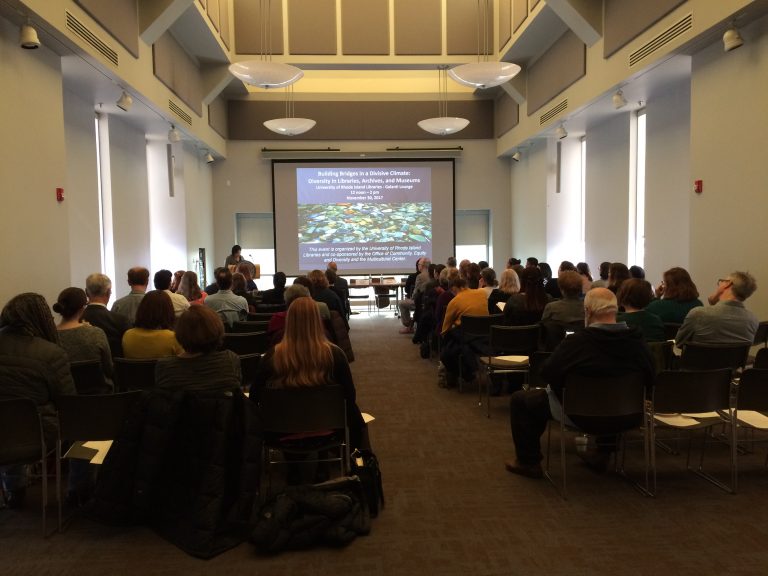
Discussion at the “Building Bridges in a Divisive Climate: Diversity in Libraries, Archives, and Museums,” at the University of Rhode Island Libraries

Another thing I would like to share is the questions that I created for the panel discussion. Even though we had a whole hour, I was able to cover only several of them. But since I discussed all these questions in advance with the panelists and they helped me put a final touch on some of those, I think these questions can be useful to future organizers who may want to run a similar program. They can be utilized for a panel discussion, an unconference, or other types of programs. I hope this is helpful and save time for other organizers.

Sample Questions for the Diversity Panel Discussion

  1. Why should libraries, archives, museums pay attention to the issues related to diversity, equity, and inclusion?
  2. In what ways do you think the lack of diversity in our profession affects the perception of libraries, museums, and archives in the communities we serve?
  3. Do you have any personal or work-related stories that you would like to share that relate to diversity, equity, and inclusion issues?
  4. How did you get interested in diversity, equity, and inclusion issues?
  5. Suppose you discovered that your library’s, archive’s or museum’s collection includes prejudiced information, controversial objects/ documents, or hate-inducing material. What would you do?
  6. Suppose a group of your library / archive / museum patrons want to use your space to hold a local gathering that involves hate speech. What would you do? What would you be mostly concerned about, and what would the things that you would consider to make a decision on how you will respond?
  7. Do you think libraries, archives, and museums are a neutral place? What do you think neutrality means to a library, an archive, a museum in practice in a divisive climate such as now?
  8. What are some of the areas in libraries, museums, and archives where you see privileges and marginalization function as a barrier to achieving our professional values – equal access and critical thinking?  What can we do to remove those barriers?
  9. Could you tell us how colonialist thinking and practice are affecting libraries, museums, and archives either consciously or unconsciously?  Since not everyone is familiar with what colonialism is, please begin with first your brief interpretation of what colonialist thinking or practice look like in libraries, museums, and archives first?
  10. What do you think libraries, archives, and museums can do more to improve critical thinking in the community that we serve?
  11. Although libraries, archives, museums have been making efforts to recruit, hire, and retain diverse personnel in recent years, the success rate has been relatively low. For example, in librarianship, it has been reported that often those hired through these efforts experienced backlash at their own institutions, were subject to unrealistic expectations, and met with unsupportive environment, which led to burnout and a low retention rate of talented people. From your perspective – either as a manager hiring people or a relatively new librarian who looked for jobs – what do you think can be done to improve this type of unfortunate situation?
  12. Many in our profession express their hesitation to actively participate in diversity, equity, and inclusion-related discussion and initiatives at their institutions because of the backlash from their own coworkers. What do you think we can do to minimize such backlash?
  13. Some people in our profession express strong negative feelings regarding diversity, equity, and inclusion-related initiatives. How much of this type of anti-diversity sentiment do you think exist in your field? Some worry that this is even growing faster in the current divisive and intolerant climate. What do you think we can do to counter such anti-diversity sentiment?
  14. There are many who are resistant to the values of diversity, equity, and inclusion. Have you taken any action to promote and advance these values facing such resistance? If so, what was your experience like, and what would be some of the strategies you may recommend to others working with those people?
  15. Many people in our profession want to take our diversity, equity, and inclusion initiatives to the next level, beyond offering mere lip service or simply playing a numbers game for statistics purpose. What do you think that next level may be?

Lastly, I felt strongly about ensuring that the terms and concepts often thrown out in diversity/equity/inclusion-related programs and events – such as intersectionality, white privilege, microaggression, patriarchy, colonialism, and so on – are not used to unintentionally alienate those who are unfamiliar with them. These concepts are useful and convenient shortcuts that allow us to communicate a large set of ideas previously discussed and digested, so that we can move our discussion forward more efficiently. They should not make people feel uncomfortable nor generate any hint of superiority or inferiority.

To this end, I create a pre-program survey which all program registrants were encouraged to take. My survey simply asked people how familiar and how comfortable they are with a variety of terms. At the panel discussion program, we also distributed the glossary of these terms, so that people can all become familiar with them.9 Also, videos can quickly bring all attendees up-to-speed with some basic concepts and phenomena in diversity discussion. For example, in the beginning of our panel discussion program, I played two short videos, “Life of Privilege Explained in a $100 Race” and “What If We Treated White Coworkers The Way We Treat Minority Coworkers?”, which were well received by the attendees.

I am sharing the survey questions, the video links, and the glossary in the hope that they may be helpful as a useful tool for future organizers. For example, one may decide to provide a glossary like this before the program or run an unconference that aims at unpacking the meanings of these terms and discussing how they relate to people’s daily lives.10

In Closing: Diversity, Libraries, Technology, and Our Own Biases

Disagreements on social issues are natural. But the divisiveness that we are currently experiencing seems to be particularly intense. This deeply concerns us, educators and professionals working in libraries, archives, and museums. Libraries, archives, and museums are public institutions dedicated to promoting and advancing civic values. Diversity, equity, and inclusion are part of those core civic values that move our society forward. This task, however, has become increasingly challenging as our society moves in a more and more divisive direction.

To make matters even more complicated, libraries, archives, museums in general lack diversity in their staff composition. This homogeneity can impede achieving our own mission. According to the recent report from Ithaka S+R released this August, we do not appear to have gotten very far. Their report “Inclusion, Diversity, and Equity: Members of the Association of Research (ARL) Libraries – Employee Demographics and Director Perspectives,” shows that libraries and library leadership/administration are both markedly white-dominant (71% and 89% white non-Hispanic respectively).11 Also, while librarianship in general are female dominant (61%), the technology field in libraries is starkly male (70%) along with Makerspace (65%), facilities (64%), and security (73%) positions.12 The survey results in the report show that while the majority of library directors say there are barriers to achieving more diversity in their library, they attribute those barriers to external rather than internal factors such as the library’s geographic location and the insufficiently diverse application pool resulting from the library’s location. What is fascinating, however, is that this directly conflicts with the fact that libraries do show little variation in the ratio of white staff based on degree of urbanization. Equally interesting is that the staff in more homogeneous and less diverse (over 71% White Non-Hispanic) libraries think that their libraries are much more equitable than the library community (57% vs 14%) and that library directors (and staff) consider their own library to be more equitable, diverse, and inclusive than the library community with respect to almost every category such as race/ethnicity, gender, LGBTQ, disabilities, veterans, and religion.

While these findings in the Ithaka S+R report are based upon the survey results from ARL libraries, similar staff composition and attitudes can be assumed to apply to libraries in general. There is a great need for both the library administration and the staff to understand their own unconscious and implicit biases, workplace norms, and organizational culture that may well be thwarting their own diversity efforts.

Diversity, equity, and inclusion have certainly been a topic of active discussion in the recent years. Many libraries have established a committee or a task force dedicated to improving diversity. But how are those efforts paying out? Are they going beyond simply paying a lip service? Is it making a real difference to everyday experience of minority library workers?13 Can we improve, and if so where and how? Where do we go from here? Those would be the questions that we will need to examine in order to take our diversity efforts in libraries, archives, and museums to the next level.

Notes

  1. The program description is available at https://web.uri.edu/library/2017/12/05/building-bridges-in-a-divisive-climate-diversity-in-libraries-archives-and-museums/
  2. Carol Bean, Ranti Junus, and Deborah Mouw, “Conference Report: Code4LibCon 2008,” The Code4Lib Journal, no. 2 (March 24, 2008), http://journal.code4lib.org/articles/72.
  3. Note that this kind of biased assertions often masquerades itself as an objective intellectual pursuit in academia when in reality, it is a direct manifestation of an existing prejudice reflecting the limited and shallow experience of the person posting the question him/herself. A good example of this is found in the remark in 2005 made by Larry Summers, the former Harvard President. He suggested that one reason for relatively few women in top positions in science may be “issues of intrinsic aptitude” rather than widespread indisputable everyday discrimination against women. He resigned after the Harvard faculty of arts and sciences cast a vote of no confidence. See Scott Jaschik, “What Larry Summers Said,” Inside Higher Ed, February 18, 2005, https://www.insidehighered.com/news/2005/02/18/summers2_18.
  4. Our pre-program survey questions can be viewed at https://docs.google.com/forms/d/e/1FAIpQLScP-nQnkHAqli_43pVdidw-dQzrAfLyCdiKutu5dZjqm3F8rA/viewform.
  5. For this purpose, asking all participants to respect one another’s privacy in advance can be a good policy. In addition to this, we specifically decided not to stream or record our panel discussion program, so that both panelists and attendees can freely share their experience and thoughts.
  6. A good example is the Search Advocate program from Oregon State University. See http://searchadvocate.oregonstate.edu/.
  7. For an example, see the workshops offered by the Office of Community, Equity, and Inclusion of the University of Rhode Island at https://web.uri.edu/diversity/ced-inclusion-courses-overview/.
  8. For the limitations of the mainstream diversity discussion in LIS (library and information science) with the focus on inclusion and cultural competency, see David James Hudson, “On ‘Diversity’ as Anti-Racism in Library and Information Studies: A Critique,” Journal of Critical Library and Information Studies 1, no. 1 (January 31, 2017), https://doi.org/https://doi.org/10.24242/jclis.v1i1.6.
  9. You can see our glossary at https://drive.google.com/file/d/1UCI142HUuYTrElgnY-dbNSOXF_IlpM6n/view?usp=sharing; This glossary was put together by Renee Neely.
  10. For the nitty-gritty logistical details for organizing a large event with a group of local and remote volunteers, check the Organizer’s Toolkit created by the 2017 #critlib Unconference organizers at https://critlib2017.wordpress.com/organizers-toolkit/.
  11. Roger Schonfeld and Liam Sweeney, “Inclusion, Diversity, and Equity: Members of the Association of Research Libraries,” Ithaka S+R, August 30, 2017, http://www.sr.ithaka.org/publications/inclusion-diversity-and-equity-arl/.
  12. For the early discussion of diversity-focused recruitment in library technology, see Jim Hahn, “Diversity Recruitment in Library Information Technology,” ACRL TechConnect Blog, August 1, 2012, https://acrl.ala.org/techconnect/post/diversity-recruitment-in-library-information-technology.
  13. See April Hathcock, “White Librarianship in Blackface: Diversity Initiatives in LIS,” In the Library with the Lead Pipe, October 7, 2015, http://www.inthelibrarywiththeleadpipe.org/2015/lis-diversity/ and Angela Galvan, “Soliciting Performance, Hiding Bias: Whiteness and Librarianship,” In the Library with the Lead Pipe (blog), June 3, 2015, http://www.inthelibrarywiththeleadpipe.org/2015/soliciting-performance-hiding-bias-whiteness-and-librarianship.
Posted in Diversity | Tagged , , | Comments Off on Taking Diversity to the Next Level

From Need to Want: How to Maximize Social Impact for Libraries, Archives, and Museums

At the NDP at Three event organized by IMLS yesterday, Sayeed Choudhury on the “Open Scholarly Communications” panel suggested that libraries think about return on impact in addition to return on investment (ROI). He further elaborated on this point by proposing a possible description of such impact. His description was that when an object or resource created through scholarly communication efforts is being used by someone we don’t know and is interpreted correctly without contacting us (=libraries, archives, museums etc.), that is an impact; to push that further, if someone uses the object or the resource in a way we didn’t anticipate, that’s an impact; if it is integrated into someone’s workflow, that’s also an impact.

This emphasis on impact as a goal for libraries, archives, and museums (or non-profit organizations in general to apply broadly) resonated with me particularly because I gave a talk just a few days ago to a group of librarians at the IOLUG conference about how libraries can and should maximize their social impact in the context of innovation in the way many social entrepreneurs have been already doing for quite some time. In this post, I would like to revisit one point that I made in that talk. It is a specific interpretation of the idea of maximizing social impact as a conscious goal for libraries, archives, and museums (LAM). Hopefully, this will provide a useful heuristic for LAM institutions in mapping out the future efforts.

Considering that ROI is a measure of cost-effectiveness, I believe impact is a much better goal than ROI for LAM institutions. We often think that to collect, organize, provide equitable access to, and preserve information, knowledge, and cultural heritage is the goal of a library, an archive, and a museum. But doing that well doesn’t mean simply doing it cost-effectively. Our efforts no doubt aim at achieving better-collected, better-organized, better-accessed, and better-preserved information, knowledge, and cultural heritage. However, our ultimate end-goal is attained only when such information, knowledge, and cultural heritage is better used by our users. Not simply better accessed, but better used in the sense that the person gets to leverage such information, knowledge, and cultural heritage to succeed in whatever endeavor that s/he was making, whether it be career success, advanced education, personal fulfillment, or private business growth. In my opinion, that’s the true impact that LAM institutions should aim at. If that kind of impact were a destination, cost-effectiveness is simply one mode of transportation, preferred one maybe but not quite comparable to the destination in terms of importance.

But what does “better used” exactly mean? “Integrated into people’s workflow” is a hint; “unanticipated use” is another clue. If you are like me and need to create and design that kind of integrated or unanticipated use at your library, archive, or museum, how will you go about that? This is the same question we ask over and over again. How do you plan and implement innovation? Yes, we will go talk to our users, ask what they would like to see, meet with our stakeholders and find out their interests and concerns are, discuss ourselves what we can do to deliver things that our users want, and go from there to another wonderful project we work hard for. Then after all that, we reach a stage where we stop and wonder where that “greater social impact” went in almost all our projects. And we frantically look for numbers. How many people accessed what we created? How many downloads? What does the satisfaction survey say?

In those moments, how does the “impact” verbiage help us? How does that help us in charting our actual path to creating and maximizing our social impact more than the old-fashioned “ROI” verbiage? At least ROI is quantifiable and measurable. This, I believe, is why we need a more concrete heuristic to translate the lofty “impact” to everyday “actions” we can take. Maybe not quite as specific as to dictate what exactly those actions are at each project level but a bit more specific to enable us to frame the value we are attempting to create and deliver at our LAM institutions beyond cost-effectiveness.

I think the heuristic we need is the conversion of need to demand. What is an untapped need that people are not even aware of in the realm of information, knowledge, and cultural heritage? When we can identify any such need in a specific form and successfully convert that need to a demand, we make an impact. By “demand,” I mean the kind of user experience that people will desire and subsequently fulfill by using that object, resource, tool, service, etc., we create at our library, archive, and museum. (One good example of such desirable UX that comes to my mind is NYPL Photo Booth: https://www.nypl.org/blog/2013/08/12/snapshots-nypl.) When we create a demand out of such an untapped need, when the fulfillment of that kind of demand effectively creates, strengthens, and enriches our society in the direction of information, knowledge, evidence-based decisions, and truth being more valued, promoted, and equitably shared, I think we get to maximize our social impact.

In the last “Going Forward” panel where the information discovery was discussed, Loretta Parham pointed out that in the corporate sector, information finds consumers, not the other way. By contrast, we (by which I mean all of us working at LAM institutions) still frame our value in terms of helping and supporting users access and use our material, resources, and physical and digital objects and tools. This is a mistake in my opinion, because it is a self-limiting value proposition for libraries, archives, and museums.

What is the point of us LAM institutions, working so hard to get the public to use their resources and services? The end goal is so that we can maximize our social impact through such use. The rhetoric of “helping and supporting people to access and use our resources” does not adequately convey that. Businesses want their clients to use their goods and services, of course. But their real target is the making of profit out of those uses, aka purchases.

Similarly, but far more importantly, the real goal of libraries, archives and museums is to move the society forward, closer in the direction of knowledge, evidence-based decisions, and truth being more valued, promoted, and equitably shared. One person at a time, yes, but the ultimate goal reaching far beyond individuals. The end goal is maximizing our impact on this side of the public good.


Posted in Librarianship, Library, management, Usability, user experience | Tagged , , , , , , , , , , , , | Comments Off on From Need to Want: How to Maximize Social Impact for Libraries, Archives, and Museums

How to Price 3D Printing Service Fees

** This post was originally published in ACRL TechConnect on May. 22, 2017.***

Many libraries today provide 3D printing service. But not all of them can afford to do so for free. While free 3D printing may be ideal, it can jeopardize the sustainability of the service over time. Nevertheless, many libraries tend to worry about charging service fees.

In this post, I will outline how I determined the pricing schema for our library’s new 3D Printing service in the hope that more libraries will consider offering 3D printing service if having to charge the fee is a factor stopping them. But let me begin with libraries’ general aversion to fees.

A 3D printer in action at the Health Sciences and Human Services Library (HS/HSL), Univ. of Maryland, Baltimore

Service Fees Are Not Your Enemy

Charging fees for the library’s service is not something librarians should regard as a taboo. We live in the times in which a library is being asked to create and provide more and more new and innovative services to help users successfully navigate the fast-changing information landscape. A makerspace and 3D printing are certainly one of those new and innovative services. But at many libraries, the operating budget is shrinking rather than increasing. So, the most obvious choice in this situation is to aim for cost-recovery.

It is to be remembered that even when a library aims for cost-recovery, it will be only partial cost-recovery because there is a lot of staff time and expertise that is spent on planning and operating such new services. Libraries should not be afraid to introduce new services requiring service fees because users will still benefit from those services often much more greatly than a commercial equivalent (if any). Think of service fees as your friend. Without them, you won’t be able to introduce and continue to provide a service that your users need. It is a business cost to be expected, and libraries will not make profit out of it (even if they try).

Still bothered? Almost every library charges for regular (paper) printing. Should a library rather not provide printing service because it cannot be offered for free? Library users certainly wouldn’t want that.

Determining Your Service Fees

What do you need in order to create a pricing scheme for your library’s 3D printing service?

(a) First, you need to list all cost-incurring factors. Those include (i) the equipment cost and wear and tear, (ii) electricity, (iii) staff time & expertise for support and maintenance, and (iv) any consumables such as 3d print filament, painter’s tape. Remember that your new 3D printer will not last forever and will need to be replaced by a new one in 3-5 years.

Also, some of these cost-incurring factors such as staff time and expertise for support is fixed per 3D print job. On the other hand, another cost-incurring factor, 3D print filament, for example, is a cost factor that increases in proportion to the size/density of a 3d model that is printed. That is, the larger and denser a 3d print model is, the more filament will be used incurring more cost.

(b) Second, make sure that your pricing scheme is readily understood by users. Does it quickly give users a rough idea of the cost before their 3D print job begins? An obscure pricing scheme can confuse users and may deter them from trying out a new service. That would be bad user experience.

Also in 3D printing, consider if you will also charge for a failed print. Perhaps you do. Perhaps you don’t. Maybe you want to charge a fee that is lower than a successful print. Whichever one you decide on, have that covered since failed prints will certainly happen.

(c) Lastly, the pricing scheme should be easily handled by the library staff. The more library staff will be involved in the entire process of a library patron using the 3D printing service from the beginning to the end, the more important this becomes. If the pricing scheme is difficult for the staff to work with when they need charge for and process each 3D print job, the new 3D printing service will increase their workload significantly.

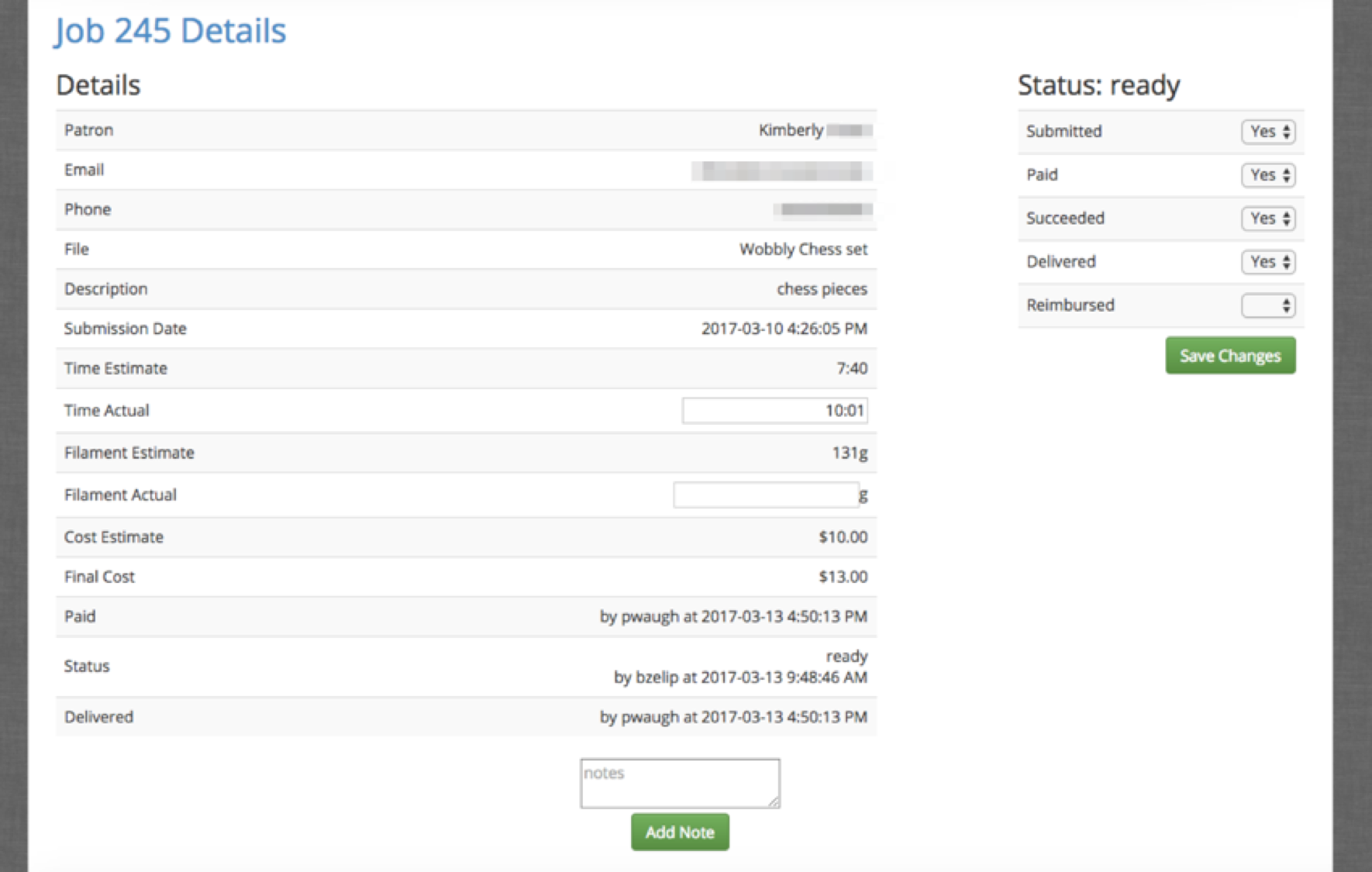
Which staff will be responsible for which step of the new service? What would be the exact tasks that the staff will need to do? For example, it may be that several staff at the circulation desk need to learn and handle new tasks involving the 3D printing service, such as labeling and putting away completed 3D models, processing the payment transaction, delivering the model, and marking the job status for the paid 3D print job as ‘completed’ in the 3D Printing Staff Admin Portal if there is such a system in place. Below is the screenshot of the HS/HSL 3D Printing Staff Admin Portal developed in-house by the library IT team.

The HS/HSL 3D Printing Staff Admin Portal, University of Maryland, Baltimore

Examples – 3D Printing Service Fees

It’s always helpful to see how other libraries are doing when you need to determine your own pricing scheme. Here are some examples that shows ten libraries’ 3D printing pricing scheme changed over the recent three years.

  • UNR DeLaMare Library
    • https://guides.library.unr.edu/3dprinting
    • 2014 – $7.20 per cubic inch of modeling material (raised to $8.45 starting July, 2014).
    • 2017 – uPrint – Model Material: $4.95 per cubic inch (=16.38 gm=0.036 lb)
    • 2017 – uPrint – Support Materials: $7.75 per cubic inch
  • NCSU Hunt Library
    • https://www.lib.ncsu.edu/do/3d-printing
    • 2014-  uPrint 3D Printer: $10 per cubic inch of material (ABS), with a $5 minimum
    • 2014 – MakerBot 3D Printer: $0.35 per gram of material (PLA), with a $5 minimum
    • 2017 – uPrint – $10 per cubic inch of material, $5 minimum
    • 2017 – F306 – $0.35 per gram of material, $5 minimum
  • Southern Illinois University Library
    • http://libguides.siue.edu/3D/request
    • 2014 – Originally $2 per hour of printing time; Reduced to $1 as the demand grew.
    • 2017 – Lulzbot Taz 5, Luzbot mini – $2.00 per hour of printing time.
  • BYU Library
  • University of Michigan Library
    • The Cube 3D printer checkout is no longer offered.
    • 2017 – Cost for professional 3d printing service; Open access 3d printing is free.
  • GVSU Library
  • University of Tennessee, Chattanooga Library
  • Port Washington Public library
  • Miami University
    • 2014 – $0.20 per gram of the finished print; 2017 – ?
  • UCLA Library, Dalhousie University Library (2014)
    • Free

Types of 3D Printing Service Fees

From the examples above, you will notice that many 3d printing service fee schemes are based upon the weight of a 3D-print model. This is because these libraries are trying recover the cost of the 3d filament, and the amount of filament used is most accurately reflected in the weight of the resulting 3D-printed model.

However, there are a few problems with the weight-based 3D printing pricing scheme. First, it is not readily calculable by a user before the print job, because to do so, the user will have to weigh a model that s/he won’t have until it is 3D-printed. Also, once 3D-printed, the staff will have to weigh each model and calculate the cost. This is time-consuming and not very efficient.

For this reason, my library considered an alternative pricing scheme based on the size of a 3D model. The idea was that we will have roughly three different sizes of an empty box – small, medium, and large –  with three different prices assigned. Whichever box into which a user’s 3d printed object fits will determine how much the user will pay for her/his 3D-printed model. This seemed like a great idea because it is easy to determine how much a model will cost to 3d-print to both users and the library staff in comparison to the weight-based pricing scheme.

Unfortunately, this size-based pricing scheme has a few significant flaws. A smaller model may use more filament than a larger model if it is denser (meaning the higher infill ratio). Second, depending on the shape of a model, a model that fits  in a large box may use much less filament than the one that fits in a small box. Think about a large tree model with think branches. Then compare that with a 100% filled compact baseball model that fits into a smaller box than the tree model does. Thirdly, the resolution that determines a layer height may change the amount of filament used even if what is 3D-printed is a same model.

Different infill ratios – Image from https://www.packtpub.com/sites/default/files/Article-Images/9888OS_02_22.png

Charging Based upon the 3D Printing Time

So we couldn’t go with the size-based pricing scheme. But we did not like the problems of the weight-based pricing scheme, either. As an alternative, we decided to go with the time-based pricing scheme because printing time is proportionate to how much filament is used, but it does not require that the staff weigh the model each time. A 3D-printing software gives an estimate of the printing time, and most 3D printers also display actual printing time for each model printed.

First, we wanted to confirm the hypothesis that 3D printing time and the weight of the resulting model are proportionate to each other. I tested this by translating the weight-based cost to the time-based cost based upon the estimated printing time and the estimated weight of several cube models. Here is the result I got using the Makerbot Replicator 2X.

  • 9.10 gm/36 min= 0.25 gm per min.
  • 17.48 gm/67 min= 0.26 gm per min.
  • 30.80 gm/117 min= 0.26 gm per min.
  • 50.75 gm/186 min=0.27 gm per min.
  • 87.53 gm/316 min= 0.28 gm per min.
  • 194.18 gm/674 min= 0.29 gm per min.

There is some variance, but the hypothesis holds up. Based upon this, now let’s calculate the 3d printing cost by time.

3D plastic filament is $48 for ABS/PLA and $65 for the dissolvable per 0.90 kg  (=2.00 lb) from Makerbot. That means that filament cost is $0.05 per gram for ABS/PLA and $0.07 per gram for the dissolvable. So, 3D filament cost is 6 cents per gram on average.

Finalizing the Service Fee for 3D Printing

For an hour of 3D printing time, the amount of filament used would be 15.6 gm (=0.26 x 60 min). This gives us the filament cost of 94 cents per hour of 3D printing (=15.6 gm x 6 cents). So, for the cost-recovery of filament only, I get roughly $1 per hour of 3D printing time.

Earlier, I mentioned that filament is only one of the cost-incurring factors for the 3D printing service. It’s time to bring in those other factors, such as hardware wear/tear, staff time, electricity, maintenance, etc., plus “no-charge-for-failed-print-policy,” which was adopted at our library. Those other factors will add an additional amount per 3D print job. And at my library, this came out to be about $2. (I will not go into details about how these have been determined because those will differ at each library.) So, the final service fee for our new 3D printing service was set to be $3 up to 1 hour of 3D printing + $1 per additional hour of 3D printing. The $3 is broken down to $1 per hour of 3D printing that accounts for the filament cost and $2 fixed cost for every 3D print job.

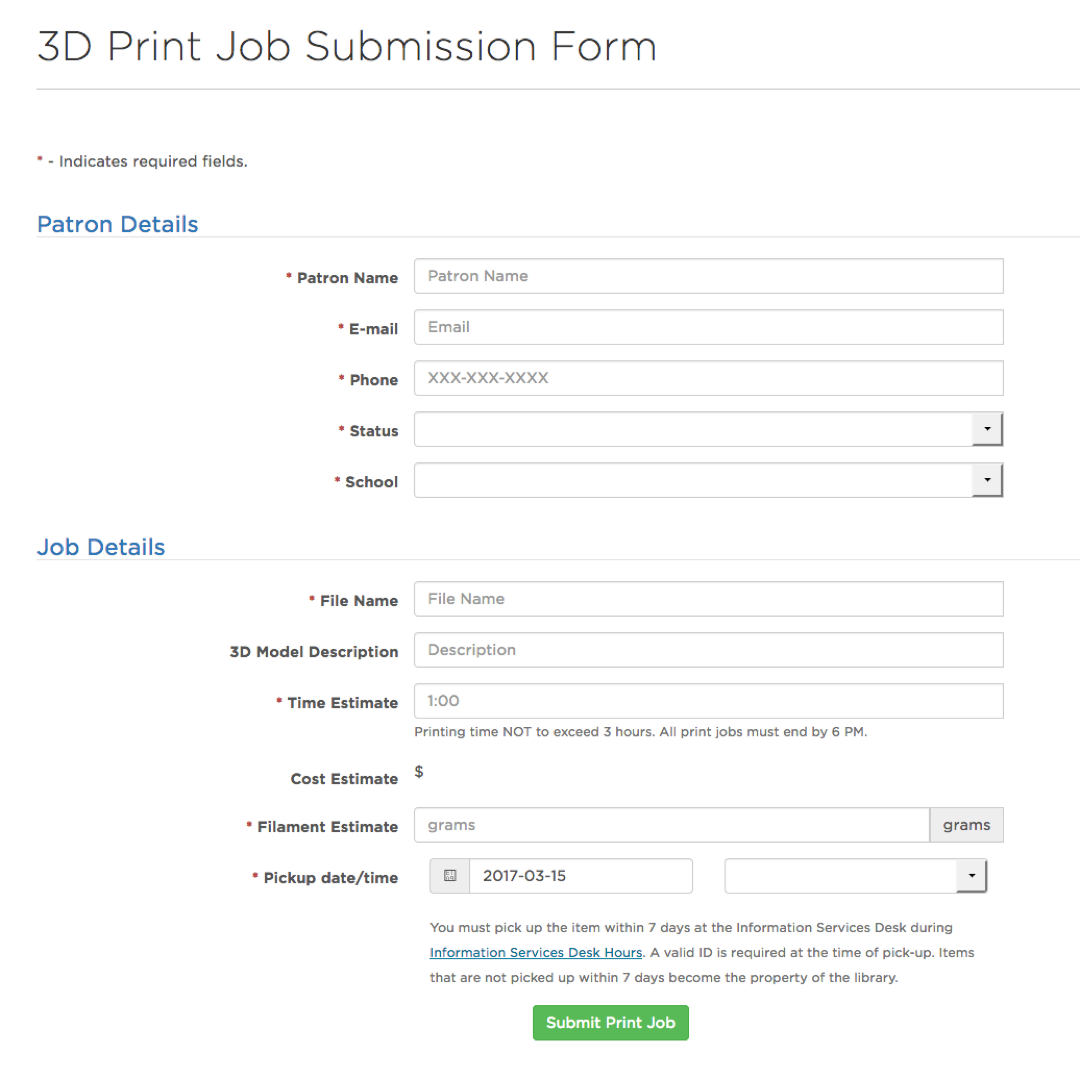
To help our users to quickly get an idea of how much their 3D print job will cost, we have added a feature to the HS/HSL 3D Print Job Submission Form online. This feature automatically calculates and displays the final cost based upon the printing time estimate that a user enters.


The HS/HSL 3D Print Job Submission form, University of Maryland, Baltimore

Don’t Be Afraid of Service Fees

I would like to emphasize that libraries should not be afraid to set service fees for new services. As long as they are easy to understand and the staff can explain the reasons behind those service fees, they should not be a deterrent to a library trying to introduce and provide a new innovative service.

There is a clear benefit in running through all cost-incurring factors and communicating how the final pricing scheme was determined (including the verification of the hypothesis that 3D printing time and the weight of the resulting model are proportionate to each other) to all library staff who will be involved in the new 3D printing service. If any library user inquire about or challenges the service fee, the staff will be able to provide a reasonable explanation on the spot.

I implemented this pricing scheme at the same time as the launch of my library’s makerspace (the HS/HSL Innovation Space at the University of Maryland, Baltimore – http://www.hshsl.umaryland.edu/services/ispace/) back in April 2015. We have been providing 3D printing service and charging for it for more than two years. I am happy to report that during that entire duration, we have not received any complaint about the service fee. No library user expected our new 3D printing service to be free, and all comments that we received regarding the service fee were positive. Many expressed a surprise at how cheap our 3D printing service is and thanked us for it.

To summarize, libraries should be willing to explore and offer new innovating services even when they require charging service fees. And if you do so, make sure that the resulting pricing scheme for the new service is (a) sustainable and accountable, (b) readily graspable by users, and (c) easily handled by the library staff who will handle the payment transaction. Good luck and happy 3D printing at your library!

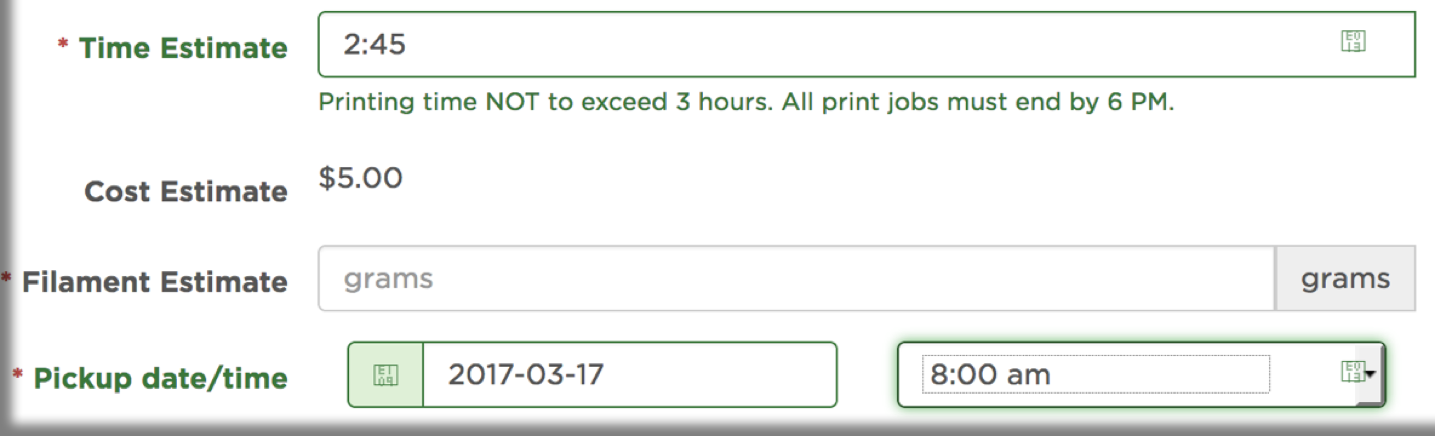
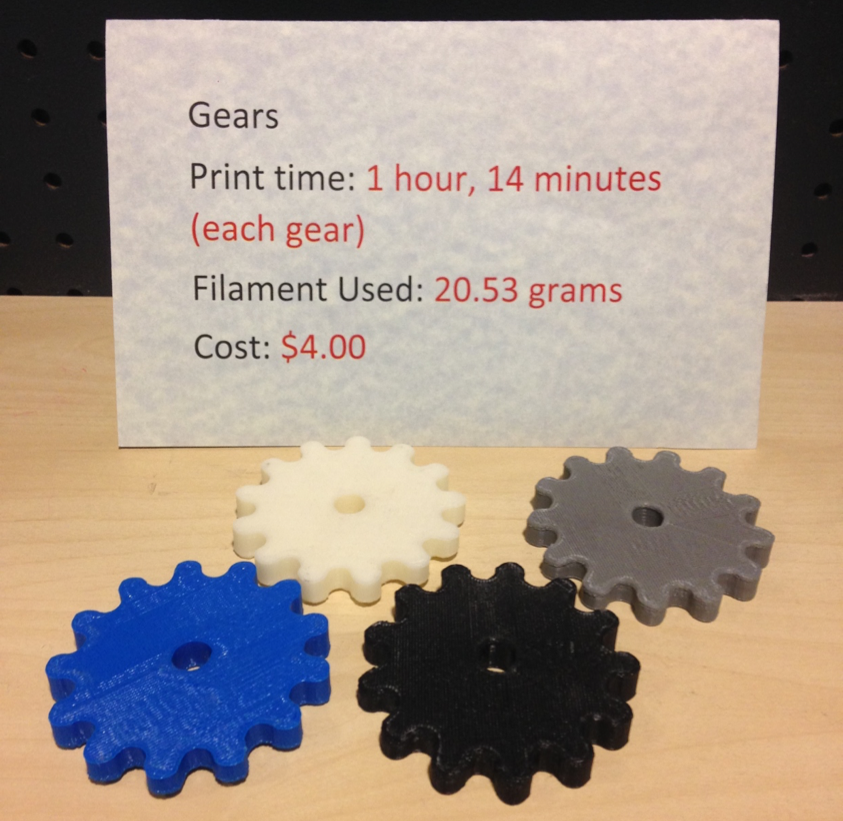
An example model with the 3D printing cost and the filament info displayed at the HS/HSL, University of Maryland, Baltimore

Posted in Library, management, Technology, user experience | Tagged , , , , , , , , , , | Comments Off on How to Price 3D Printing Service Fees

Post-Election Statements and Messages that Reaffirm Diversity

These are statements and messages sent out publicly or internally to re-affirm diversity, equity, and inclusion by libraries or higher ed institutions. I have collected these – some myself and many others through my fellow librarians. Some of them were listed on my blog post, “Finding the Right Words in Post-Election Libraries and Higher Ed.” So there are some duplicates.

If you think that your organization is already so much pro-diversity that there is no need to confirm or re-affirm diversity, you can’t be farther from the everyday reality that minorities experience. Sometimes, saying isn’t much. But right now, saying it out loud can mean everything. If you support those who belong to minority groups but don’t say it out loud, how would they know it? Right now, nothing is obvious other than there is a lot of hate and violence towards minorities.

Feel free to use these as your resource to craft a similar message. Feel free to add if you have similar messages you have received or created in the comments section.

If you haven’t heard from the organization you belong to, please ask for a message reaffirming and committing to diversity, equity, and inclusion.

[UPDATE 11/15/2016: Statements from ALA and LITA have been released. I have added them below.]

I will continue to add additional statements as I find them. If you see anything missing, please add below in the comment or send it via Twitter @bohyunkim. Thanks!

From Librarians

From Library Associations

From Libraries

From Higher Ed Institutions

Drexel University

Moving On as a Community After the Election

Dear Members of the Drexel Community,

It is heartening to me to see the Drexel community come together over the last day to digest the news of the presidential election — and to do so in the spirit of support and caring that is so much a part of this University. We gathered family-style, meeting in small, informal groups in several places across campus, including the Student Center for Inclusion and Culture, our residence halls, and as colleagues over a cup of coffee. Many student leaders, particularly from our multicultural organizations, joined the conversation.

This is not a process that can be completed in just one day, of course. So I hope these conversations will continue as long as students, faculty and professional staff feel they are needed, and I want to assure you that our professional staff in Student Life, Human Resources, Faculty Affairs, as well as our colleagues in the Lindy Center for Civic Engagement, will be there for your support.

Without question, many members of our community were deeply concerned by the inflammatory rhetoric and hostility on the campaign trail that too often typified this bitter election season.

As I wrote over the summer, the best response to an uncertain and at times deeply troubling world is to remain true to our values as an academic community. In the context of a presidential election, it is vital that we understand and respect that members of our broadly diverse campus can hold similarly diverse political views. The expression of these views is a fundamental element of the free exchange of ideas and intellectual inquiry that makes Drexel such a vibrant institution.

At the same time, Drexel remains committed to ensuring a welcoming, inclusive, and respectful environment. Those tenets are more important than ever.

While we continue to follow changes on the national scene, it is the responsibility of each of us at Drexel to join together to move ahead, unified in our commitment to open dialogue, civic engagement and inclusion.

I am grateful for all you do to support Drexel as a community that welcomes and encourages all of its members.

Lane Community College

Good Morning, Colleagues,

I am in our nation’s capital today. I’d rather be at home! Like me, I am guessing that many of you were glued to the media last night to find out the results of the election. Though we know who our next President will be, this transition still presents a lot of uncertainty. It is not clear what our future president’s higher education policies will be but we will be working with our national associations to understand and influence where we can.

During times like this there is an opening for us to decide how we want to be with each other. Moods will range from joy to sadness and disbelief. It seems trite but we do need to work together, now more than ever. As educators we have a unique responsibility to create safe learning environments where every student can learn and become empowered workers and informed citizens. This imperative seems even more important today. Our college values of equity and inclusion have not changed and will not change and it is up to each of us to assure that we live out our values in every classroom and in each interaction. Preparing ourselves and our students for contentious discussions sparked by the election is work we must do.

It is quite likely that some of our faculty, staff and students may be feeling particularly vulnerable right now. Can we reach out to each other and let each other know that we all belong at Lane? During my inservice remarks I said that “we must robustly reject the calculated narrative of cynicism, division and despair. Instead of letting this leak into our narratives, together we can bet on hope not fear, respect not hate, unity not division.” At Lane we have the intellect (and proud of it) and wherewithal to do this.

I am attaching a favorite reading from Meg Wheatley which is resonating with me today and will end with Gary Snyder’s words from To The Children …..stay together learn the flowers go light.

Maryland Institute College of Art

Post-Election Community Forums and Support

Dear Campus Community,

No matter how each of us voted yesterday, most of us likely agree that the presidential campaign has been polarizing on multiple fronts. As a result, today is a difficult day for our nation and our campus community. In our nation, regardless of how one has aligned with a candidate, half of our country feels empowered and the other half sad and perhaps angry. Because such dynamics and feelings need to be addressed and supported on campus, this memo outlines immediate resources for our community of students, faculty and staff, and describes opportunities for fashioning dialogues and creative actions going forward.

Before sharing the specifics, let me say unambiguously that MICA will always stand firm in our commitment to diversity and inclusion. This morning’s Presidential Task Force on Diversity, Inclusion, Equity, and Globalization meeting discussed measures to ensure that, as a creative community, we will continue to build a culture where everyone is honored and supported for success. The impact of exhibitions such as the current Baltimore Rising show remains as critical as ever, and MICA fosters an educational environment that is welcoming of all.

In the short term our focus is to support one another. Whether you are happy or distressed with the results, there has been sufficient feedback to indicate that our campus community is struggling with how to make sense of such a divisive election process. You may find the following services helpful and are encouraged to take advantage of them:

For Students: Student Counseling maintains walk-in hours from 3:00 – 4:00 pm every day. Students are welcome to stop by the Student Counseling Center (1501 Mt. Royal Avenue) during that time or call 410-669-9200 and enter x2367 once the recording begins to schedule an appointment.
For Faculty and Staff: The Employee Assistance Program (EAP) is available to provide free, confidential support 24 hours a day. The EAP can be reached by calling 1-866-799-2728 or visiting HealthAdvocate.com/members and providing the username “Maryland Institute College of Art”.
For all MICA community members: MICA’s chaplain, the Rev, maintains standing hours every Monday and can be reached in the Reflection Room (Meyerhoff House) or by calling the Office of Diversity and Intercultural Development at 443-552-1659.

There are three events this week that can provide a shared space for dialogue; all are welcome:

The “After the Baltimore Uprising: Still Waiting for Change” community forum attached to the Baltimore Rising exhibition takes place tonight from 7:00 pm to 9:00 pm in the Lazarus Center.
An open space for all MICA community members will be hosted by the Black Student Union tonight at 10:00 pm in the Meyerhoff House Underground.
In partnership with our student NAMI group, MICA will host a “Messages of Hope” event for the entire MICA community that will allow for shared space and reflection. This event will be on Friday, November 11th, and will begin at 3:00 pm in Cohen Plaza.

In various upcoming meetings we look forward to exploring with campus members other appropriate activities that can be created to facilitate expressions and dialogues.

A separate communication is coming from Provost David Bogen to the faculty regarding classroom conversations with students regarding the election.

Northwestern University Women’s Center

Dear Northwestern students, faculty, staff and community members:

The Women’s Center is open today. Our staff members are all here and available to talk, to provide resources and tools, or to help however you might need it. Most importantly, the space itself is available for whatever you need, whether that is to gather as a group, to sit alone somewhere comfortable and quiet, or to talk to someone who will listen. We are still here, and we are here for all people as an intentionally intersectional space. You are welcome to drop by physically, make a call to our office, or send an email. Know that this space is open and available to you.

Portland Community College to the PCC Staff

As someone who spent the last several years in Washington D.C. working to advance community colleges, I feel a special poignancy today hearing so many students, colleagues, and friends wonder and worry about the future—and about their futures.

We must acknowledge that this political season has highlighted deep divisions in our society. Today I spent time with Cabinet speaking about how we can assert our shared values and take positive action as a PCC community to deepen our commitment to equity, inclusion and civic engagement.

PCC will always welcome students and colleagues who bring a rich array of perspectives and experiences. That diversity is among our greatest strengths.

Today it is imperative that we stand by faculty, staff and students who may be experiencing fear or uncertainty—affirming with our words and deeds that PCC is about equitable student success and educational opportunity for all. Never has this mission been more powerful or more essential.

I have only been here a few months, but have already learned that PCC is a remarkable and caring community. Much is happening right now in real time, and I appreciate the efforts of all. For my part, I promise to communicate often as we continue to plan for our shared future.

P.S. Today and in the days ahead, we will be holding space for people to be together in community. Here are a few of the opportunities identified so far.

Portland Community College to Students

Dear Students:

As someone who spent the last several years working in Washington D.C., I feel a special poignancy this week hearing many of you express worry and uncertainty about the future.

There is little doubt that this political season has highlighted some deep divisions in our society. Both political candidates have acknowledged as much.

At the same time, people representing the full and diverse spectrum of our country come to our nation’s community colleges in hopes of a better life. PCC is such a place – where every year thousands of students find their path and pursue their dreams. All should find opportunity here, and all should feel safe and welcome.

The rich diversity of PCC offers an amazing opportunity for dialogue across difference, and for developing skills that are the foundation of our democratic society.

Let this moment renew your passion for making a better life for yourself, your community and your country and for becoming the kind of leader you want to follow.

Rutgers University AAUP-AFT
(American Association of University Professors – American Federation of Teachers)

Resisting Donald Trump

We are shocked and horrified that Donald Trump, who ran on a racist, xenophobic, misogynist platform, is now the President of the US. In response to this new political landscape, the administrative heads of several universities have issued statements embracing their diverse student, faculty, and staff bodies and offering support and protection. (See statements from the University of California and the California State University). President Barchi has yet to address the danger to the Rutgers community and its core mission.

This afternoon, our faculty union and the Rutgers One Coalition held an emergency meeting of students, faculty, and community activists in New Brunswick. We discussed means of responding to the attacks that people may experience in the near future. Most immediately, we approved the following statement by acclamation at the 100-strong meeting:

“Rutgers One, a coalition of faculty, staff, students and community members, calls upon the Rutgers administration to join us in condemning all acts of bigotry on this campus and refuse to tolerate any attacks on immigrants, women, Arabs, Muslims, people of color, LGBTQ people and all others in our diverse community. We demand that President Barchi and his administration provide sanctuary, support, and protection to those who are already facing attacks on our campuses. We need concrete action that can ensure a safe environment for all. Further, we commit ourselves to take action against all attempts by the Trump administration to target any of our students, staff or faculty. We are united in resistance to bigotry of every kind and welcome all to join us in solidarity.”

We also resolved to take the following steps:

We will be holding weekly Friday meetings at 3pm in our Union office in New Brunswick to bring together students, faculty and staff to organize against the Trump agenda. We hope to expand these to Camden and Newark as well. (If you are willing to help organize this, please email back.)
We will be creating a list serve to coordinate our work. If you want to join this list, please reply to this email.
We are making posters and stickers which declare sanctuaries from racism, xenophobia, sexism, bigotry, religious intolerance, and attacks on unions. Once these materials are ready we will write to you so that you may post them on windows, office doors, cars etc. In the meantime, we urge you to talk to your students and colleagues of color as well as women and offer them your support and solidarity.

As you may recall, the Executive Committee issued a denunciation of Donald Trump on October 10, 2016. Now our slogan, one from the labor movement, is “Don’t mourn. Organize!” That is where we are now – all the more poignantly because of Donald Trump’s appeal to workers. Let us organize, and let us also expand our calling of education. In your classrooms, your communities, and your families, find the words and sentiments that will redeem all of us from Tuesday’s disgrace.

University of Chicago

Message from President and Provost

Early in the fall quarter, we sent a message welcoming each of you to the new academic year and affirming our strong commitment to two foundational values of the University – fostering an environment of free expression and open discourse; and ensuring that diversity and inclusion are essential features of the fabric of our campus community and our interactions beyond campus.

Recent national events have generated waves of disturbing, exclusionary and sometimes threatening behavior around the country, particularly concerning gender and minority status. As a result, many individuals are asking whether the nation and its institutions are entering a period in which supporting the values of diversity and inclusion, as well as free expression and open discourse, will be increasingly challenging. As the president and provost of the University of Chicago, we are writing to reaffirm in the strongest possible terms our unwavering commitment to these values, and to the importance of the University as a community acting on these values every day.

Fulfilling our highest aspirations with respect to these values and their mutual reinforcement will always demand ongoing attention and work on the part of all of us. The current national environment underscores the importance of this work. It means that we need to manifest these values more rather than less, demand more of ourselves as a community, and together be forthright and bold in demonstrating what our community aspires to be. We ask all of you for your help and commitment to the values of diversity and inclusion, free expression, and open discourse and what they mean for each of us working, learning, and living in this University community every day.

University of Illinois, Chicago

Dear Students, Faculty, and Staff,

The events of the past week have come with mixed emotions for many of you. We want you to know that UIC remains steadfast in its commitment to creating and sustaining a community that recognizes and values the inherent worth and dignity of every person, while fostering an environment of mutual respect among all members.

Today, we reaffirm the University’s commitment to access, equity, inclusion and nondiscrimination. Critical to this commitment is the work of several offices on campus that provide resources to help you be safe and successful. If you have questions, need someone to talk to, or a place to express yourself, you should consider contacting these offices:

Office for Access and Equity (OAE). OAE is responsible for assuring campus compliance in matters of equal opportunity, affirmative action, and nondiscrimination in the academic and work environment. OAE also offers Dispute Resolution Services (DRS) to assist with conflict in the workplace not involving unlawful discrimination matters.

UIC Counseling Center. The UIC Counseling Center is a primary resource providing comprehensive mental health services that foster personal, interpersonal, academic, and professional thriving for UIC students.
Student Legal Services. UIC’s Student Legal Services (SLS) is a full-service law office dedicated to providing legal solutions for currently enrolled students.

Office of Diversity. The Office of Diversity leads strategic efforts to advance access, equity, and inclusion as fundamental principles underpinning all aspects of university life. It initiates programs that promote an inclusive university climate, partner with campus units to formulate systems of accountability, and develop links with the local community and alumni groups.
Centers for Cultural Understanding and Social Change. The Centers for Cultural Understanding and Social Change (CCUSC) are a collaborative group of seven centers with distinct histories, missions, and locations that promote the well-being of and cultural awareness about underrepresented and underserved groups at UIC.

UIC Dialogue Initiative. The UIC Dialogue Initiative seeks to build an inclusive campus community where students, faculty, and staff feel welcomed in their identities, valued for their contributions, and feel their identities can be openly expressed.

Through whatever changes await us, as a learning community we have a special obligation to ensure that our conversations and dialogues over the next weeks and months respect our varied backgrounds and beliefs.

University of Maryland, Baltimore

To the UMB Community:

Last week, we elected a new president for our country. I think most will agree that the campaign season was long and divisive, and has left many feeling separated from their fellow citizens. In the days since the election, I’ve heard from the leaders of UMB and of the University of Maryland Medical Center and of the many programs we operate that serve our neighbors across the city and state. These leaders have relayed stories of students, faculty, staff, families, and children who feel anxious and unsettled, who feel threatened and fearful.

It should be unnecessary to reaffirm UMB’s commitment to diversity, inclusion, and respect — these values are irrevocable — but when I hear that members of our family are afraid, I must reiterate that the University will not tolerate incivility of any kind, and that the differences we celebrate as a diverse community include not just differences of race, religion, nationality, gender, and sexual identity, but also of experience, opinion, and political affiliation and ideology. If you suffer any harassment, please contact your supervisor or your student affairs dean.

In the months ahead, we will come together as a University community to talk about how the incoming administration might influence the issues we care about most: health care access and delivery; education; innovation; social justice and fair treatment for all. We will talk about the opportunities that lay ahead to shape compassionate policy and to join a national dialogue on providing humane care and services that uplift everyone in America. For anyone who despairs, we will talk about building hope.

Should you want to share how you’re feeling post-election, counselors are available. Please contact the Student Counseling Center or the Employee Assistance Program to schedule an appointment.

I look forward to continuing this conversation about how we affirm our fundamental mission to improve the human condition and serve the public good. Like the values we uphold, this mission endures — irrespective of the person or party in political power. It is our binding promise to the leaders of this state and, even more importantly, to the citizens we serve together.

University of West Georgia

Dear Colleagues,

As we head into the weekend concluding a week, really several weeks, of national and local events, I am reminded of the incredible opportunity of reflection and discourse we have as a nation and as an institution of higher learning.

This morning, we held on campus a moving ceremony honoring our Veterans–those who have served and who have given the ultimate sacrifice to uphold and protect our freedoms.  It is those freedoms that provide the opportunity to elect a President and those freedoms that provide an environment of civil discourse and opinion.  Clearly, the discourse of this election cycle has tested the boundaries.

This is an emotional time for many of our faculty, staff, and students.  I ask that as a campus community we hold true to the intended values of our nation and those who sacrificed to protect those values and the core values of our institution–caring, collaboration, inclusiveness, and wisdom.  We must acknowledge and allow the civil discourse and opinion of all within a safe environment.  That is what should set us apart.  It is part of our DNA in higher education to respect and encourage variance and diversity of belief, thought, and culture.

I call on your professionalism during these times and so appreciate your passion and care for each other and our students.

Virginia Commonwealth University to Staff

Election Message

Dear VCU and VCU Health Communities,

Yesterday, we elected new leaders for our city, commonwealth and nation. I am grateful to those of you who made your voice heard during the electoral process, including many of our students who voted for the first time. Whether or not your preferred candidate won, you were a part of history and a part of the process that moves our democracy forward. Thank you. I hope you will always continue to make your voice heard, both as voters and as well-educated leaders in our society.

As with any election, some members of our community are enthusiastic about the winners, others are not.  For many, this election cycle was notably emotional and difficult.

Now is the time, then, to demonstrate the values that make Virginia Commonwealth University such a remarkable place.  We reaffirm our commitment to working together across boundaries of discipline or scholarship, as members of one intellectual community, to achieve what’s difficult.  We reaffirm our commitment to inclusion, to ensuring that every person who comes to VCU is respected and emboldened to succeed.  We reaffirm that we will always be a place of the highest integrity, accountability, and we will offer an unyielding commitment to serving those who need us.

History changes with every election. What does not change are the commitments we share as one community that is relentlessly focused on advancing the human experience for all people.

You continue to inspire me.  And I know you will continue to be a bright light for Richmond, Virginia, our nation and our world.

Virginia Commonwealth University School of Education to Students

Election Message

Dear students,

On Tuesday we elected new leaders for our city, our commonwealth and our nation. Although leadership will be changing, I echo Dr. Rao’s message below in that our mission outlined by the Quest for Distinction to support student success, advance knowledge and strengthen our communities remains steadfast.

At the VCU School of Education, we work to create safe spaces where innovation, inclusion and collaboration can thrive. We actively work across boundaries and disciplines to address the complex challenges facing our communities, schools and families. The election of new leaders provides new opportunities for our students, faculty and staff to build bridges that help us reach our goal of making an impact in urban and high need environments.

I encourage you to engage in positive dialogues with one another as the city, commonwealth and nation adjust to the change in leadership, vision and strategy.

Virginia Commonwealth University Division of Student Affairs

Dear Students,

We are writing to you, collectively, as leaders in the Division of Student Affairs.  We acknowledge that this election season was stressful for many individuals in our VCU community, culminating with the election of the next president.  Some members of our campus community have felt disrespected, attacked and further marginalized by political rhetoric during the political process.  We want to affirm support of all of our students while also recognizing the unique experiences and concerns of individuals. We want all students to know that we are here to support you, encourage you and contribute to your success.

We now live in a space of uncertainty as we transition leadership in our nation.  Often, with this uncertainty comes a host of thoughts and feelings.  We hope that you will take advantage of some of the following services and programs we offer through our division to support your well-being, including: Office of Multicultural Student Affairs, Self-Care Space, University Counseling Services , The Wellness Resource Center, Trans Lives Matter Panel and Survivor Solidarity Support, Recreational Sports, Restorative Yoga and Mind & Body Classes.

We encourage students to express their concerns and engage in conversations that further the core values articulated in Quest, the VCU Strategic Plan. We continue to have an opportunity to make individual and collective choices about how we work to bridge differences in a manner that builds up our community.

Our staff will have a table each day next week on the VCU Compass from noon to 1:00 p.m. ­­­to receive your concerns, suggestions and just listen.  Please stop by to meet us.  We want you to know you have our full support.

Other Organizations

Posted in Diversity, Librarianship, Library, management | Tagged , , , , , , , , | Comments Off on Post-Election Statements and Messages that Reaffirm Diversity

Finding the Right Words in Post-Election Libraries and Higher Ed

** This post was originally published in ACRL TechConnect on Nov. 15, 2016.***

This year’s election result has presented a huge challenge to all of us who work in higher education and libraries. Usually, libraries, universities, and colleges do not comment on presidential election result and we refrain from talking about politics at work. But these are not usual times that we are living in.

A black female student was shoved off the sidewalk and called the ‘N’ word at Baylor University. The Ku Klux Klan is openly holding a rally. West Virginia officials publicly made a racist comment about the first lady. Steve Bannon’s prospective appointment as the chief strategist and senior counsel to the new President is being praised by white nationalist leaders and fiercely opposed by civil rights groups at the same time. Bannon is someone who calls for an ethno-state, openly calls Martin Luther King a fraud, and laments white dispossession and the deconstruction of occidental civilization. There are people drawing a swastika at a park. The ‘Whites only’ and ‘Colored’ signs were put up over water fountains in a Florida school. A Muslim student was threatened with a lighter. Asian-American women are being assaulted. Hostile acts targeting minority students are taking place on college campuses.

Libraries and educational institutions exist because we value knowledge and science. Knowledge and science do not discriminate. They grow across all different races, ethnicities, religions, nationalities, sexual identities, and disabilities. Libraries and educational institutions exist to enable and empower people to freely explore, investigate, and harness different ideas and thoughts. They support, serve, and belong to ‘all’ who seek knowledge. No matter how naive it may sound, they are essential to the betterment of human lives, and they do so by creating strength from all our differences, not likeness. This is why diversity, equity, inclusion are non-negotiable and irrevocable values in libraries and educational institutions.

How do we reconcile these values with the president-elect who openly dismissed and expressed hostility towards them? His campaign made remarks and promises that can be interpreted as nothing but the most blatant expressions of racism, sexism, intolerance, bigotry, harassment, and violence. What will we do to address the concerns of our students, staff, and faculty about their physical safety on campus due to their differences in race, ethnicity, religion, nationality, gender, and sexual identity? How do we assure them that we will continue to uphold these values and support everyone regardless of what they look like, how they identify their gender, what their faiths are, what disabilities they may have, who they love, where they come from, what languages they speak, or where they live? How?

We say it. Explicitly. Clearly. And repeatedly.

If you think that your organization is already very much pro-diversity that there is no need to confirm or reaffirm diversity, you can’t be farther from the everyday life minorities experience. Sometimes, saying isn’t much. But right now, saying it out loud can mean everything. If you support those who belong to minority groups but don’t say it out loud, how would they know it? Right now, nothing is obvious other than there is a lot of hate and violence towards minorities.

The entire week after the election, I agonized about what to say to my small team of IT people whom I supervise at work. As a manager, I felt that it was my responsibility to address the anxiety and uncertainty that some of my staff – particularly those in minority groups – would be experiencing due to the election result. I also needed to ensure that whatever dialogue takes place regarding the differences of opinions between those who were pleased and those who were distressed with the election result, those dialogues remain civil and respectful.

Crafting an appropriate message was much more challenging than I anticipated. I felt very strongly about the need to re-affirm the unwavering support and commitment to diversity, equity, and inclusion particularly in relation to libraries and higher education, no matter how obvious it may seem. I also felt the need to establish (within the bounds of my limited authority) that we will continue to respect, value, and celebrate diversity in interacting with library users as well as other library and university staff members. Employees are held to the standard expectations of their institutions, such as diversity, equity, inclusion, tolerance, civil dialogue, and no harassment or violence towards minorities, even if their private opinions conflict with them. At the same time, I wanted to strike a measured tone and neither scare nor upset anyone, whichever side they were on in the election. As a manager, I have to acknowledge that everyone is entitled to their private opinions as long as they do not harm others.

I suspect that many of us – either a manager or not – want to say something similar about the election result. Not so much about who was and should have been as about what we are going to do now in the face of these public incidences of anger, hatred, harassment, violence, and bigotry directed at minority groups, which are coming out at an alarming pace because it affects all of us, not just minorities.

Finding the right words, however, is difficult. You have to carefully consider your role, audience, and the message you want to convey. The official public statement from a university president is going to take a tone vastly different from an informal private message a supervisor sends out to a few members of his or her team. A library director’s message to library patrons assuring the continued service for all groups of users with no discrimination will likely to be quite different from the one she sends to her library staff to assuage their anxiety and fear.

For such difficulty not to delay and stop us from what we have to and want to say to everyone we work with and care for, I am sharing the short message that I sent out to my team last Friday, 3 days after the election. (N.B. ‘CATS’ stands for ‘Computing and Technology Services’ and UMB refers to ‘University of Maryland, Baltimore.’) This is a customized message to address my own team. I am sharing this as a potential template for you to craft your own message. I would like to see more messages that reaffirm diversity, equity, and inclusion as non-negotiable values, explicitly state that we will not step backwards, and make a commitment to continued unwavering support for them.

Dear CATS,

This year’s close and divisive election left a certain level of anxiety and uncertainty in many of us. I am sure that we will hear from President Perman and the university leadership soon.

In the meantime, I want to remind you of something I believe to be very important. We are all here – just as we have been all along – to provide the most excellent service to our users regardless of what they look like, what their faiths are, where they come from, what languages they speak, where they live, and who they love. A library is a powerful place where people transform themselves through learning, critical thinking, and reflection. A library’s doors have been kept open to anyone who wants to freely explore the world of ideas and pursue knowledge. Libraries are here to empower people to create a better future. A library is a place for mutual education through respectful and open-minded dialogues. And, we, the library staff and faculty, make that happen. We get to make sure that people’s ethnicity, race, gender, disability, socio-economic backgrounds, political views, or religious beliefs do not become an obstacle to that pursuit. We have a truly awesome responsibility. And I don’t have to tell you how vital our role is as a CATS member in our library’s fulfilling that responsibility.

Whichever side we stood on in this election, let’s not forget to treat each other with respect and dignity. Let’s use this as an opportunity to renew our commitment to diversity, one of the UMB’s core values. Inclusive excellence is one of the themes of the UMB 2017-2021 Strategic Plan. Each and every one of us has a contribution to make because we are stronger for our differences.

We have much work ahead of us! I am out today, but expect lots of donuts Monday.

Have a great weekend,
Bohyun


Monday, I brought in donuts of many different kinds and told everyone they were ‘diversity donuts.’ Try it. I believe it was successful in easing some stress and tension that was palpable in my team after the election.

Photo from Flickr: https://www.flickr.com/photos/vnysia/4598569232

Photo from Flickr: https://www.flickr.com/photos/vnysia/4598569232

Before crafting your own message, I recommend re-reading your institution’s core values, mission and vision statements, and the most recent strategic plan. Most universities, colleges, and libraries include diversity, equity, inclusion, or something equivalent to these somewhere. Also review all public statements or internal messages that came from your institution that reaffirms diversity, equity, and inclusion. You can easily incorporate those into your own message. Make sure to clearly state your (and your institution’s) continued commitment to and unwavering support for diversity and inclusion and explicitly oppose bigotry, intolerance, harassment, and acts of violence. Encourage civil discourse and mutual respect. It is very important to reaffirm the values of diversity, equity, and inclusion ‘before’ listing any resources and help that employees or students may seek in case of harassment or assault. Without the assurance from the institution that it indeed upholds those values and will firmly stand by them, those resources and help mean little.

Below I have also listed messages, notes, and statements sent out by library directors, managers, librarians, and university presidents that reaffirm the full support for and commitment to diversity, equity, and inclusion. I hope to see more of these come out. If you have already received or sent out such a message, I invite you to share in the comments. If you have not, I suggest doing so as soon as possible. Send out a message if you are in a position where doing so is appropriate. Don’t forget to ask for a message addressing those values if you have not received any from your organization.


Posted in Diversity, Librarianship, Library, management | Tagged , , , , , , , , | Comments Off on Finding the Right Words in Post-Election Libraries and Higher Ed

Say It Out Loud – Diversity, Equity, and Inclusion

I usually and mostly talk about technology. But technology is so far away from my thought right now. I don’t feel that I can afford to worry about Internet surveillance or how to protect privacy at this moment. Not that they are unimportant. Such a worry is real and deserves our attention and investigation. But at a time like this when there are so many reports of public incidences of hatred, bigotry, harassment, and violence reported on university and college campuses, on streets, and in many neighborhoods coming in at an alarming pace, I don’t find myself reflecting on how we can use technology to deal with this problem. For the problem is so much bigger.

There are people drawing a swastika at a park. The ‘Whites only’ and ‘Colored’ signs were put up over water fountains in a Florida school. A Muslim student was threatened with a lighter. Asian-American women are being assaulted. Hostile acts targeting minority students are taking place on college campuses. A black female student was shoved off the sidewalk and called the ‘N’ word at Baylor University. Newt Gingrich called for a House committee for Un-American Activities. The Ku Klux Klan is openly holding a rally. The list goes on and on.

Photo from http://www.wftv.com/news/local/investigation-underway-after-2-racist-signs-posted-above-water-fountains-at-first-coast-high-school/466146633

Photo from http://www.wftv.com/news/local/investigation-underway-after-2-racist-signs-posted-above-water-fountains-at-first-coast-high-school/466146633

We are justified to be freaking out. I suspect this is a deal breaker to not just Democrats, not just Clinton supporters, but a whole lot more people. Not everyone who voted for Donald Trump endorse the position that women, people of color, Muslims, LGBT, and all other minority groups deserve and should be deprived of the basic human right to be not publicly threatened, harassed, and assaulted, I hope. I am sure that many who voted for Donald Trump do support diversity, equity, and inclusion as important and non-negotiable values. I believe that many who voted for Donald Trump do not want a society where some of their family, friends, colleagues, and neighbors have to live in constant fear for their physical safety at minimum. There are very many white people who absolutely condemn bigotry, threat, hatred, discrimination, harassment, and violence directed at minorities and give their unwavering support to diversity, equity, and inclusion.

The problem is that I don’t hear it said loudly enough, clearly enough, publicly enough.

I realized that we – myself included – do not say this enough.

One of my fellow librarians, Steve, wrote this on his Facebook wall after the election.

I am a 56 year old white guy. … I go out into the world today and I’m trying to hold a look on my face that says I don’t hate you black people, Hispanic people, gay people, Muslim people. I mean you no harm. I don’t want to deport you or imprison you. You are my brothers and sisters. I want for you all of the benefits, the rights, the joys (such as they are) that are afforded to everybody else in our society. I don’t think this look on my face is effective. Why should they trust me? You can never APPEAR to be doing the right thing. It requires DOING the right thing.

Of course, Steve doesn’t want to harm me because I am not white, I know. I am 100 % positive that he wouldn’t assault me because I am female. But by stating this publicly (I mean as far as his FB friends can see the post), he made a difference to me. Steve is not Republican. But I would feel so much better if people I know tell me the same thing whether they are Democrat or Republican. And I think it will make a huge difference to others when we all say this together.

Sometimes, saying isn’t much. But right now, saying it aloud can mean everything. If you support those who belong to minority groups but don’t say it out loud, how would they know it? Because right now, nothing is obvious other than there is a lot of hate and violence towards minorities.

At this point, which candidate you voted for doesn’t matter. What matters is whether you will condone open hatred and violence towards minorities and women, thereby making it acceptable in our society. There is a lot at stake here, and this goes way beyond party politics.

Publicly confirming our continued support for and unwavering commitment to diversity is a big deal. People who are being insulted, threatened, harassed, and assaulted need to hear it. And when we say this together loudly enough, clearly enough, explicitly enough, it will deafen the voice of hatred, bigotry, and intolerance and chase it away to the margins of our society again.

So I think I am going to say this whenever I have a chance whether formally or informally whether it is in a written form or in a conversation. If you are a librarian, you should say this to your library users. If you are a teacher, you should say this to your students. If you run a business, you need to say this to your employees and customers. If you manage a team at work, tell your team. Say this out loud to your coworkers, friends, family, neighbors, and everyone you interact with.

“I support all minorities and stand for diversity, equity, and inclusion.”

“I object to and will not condone the acts of harassment, violence, hatred, and threats directed at minorities.”

“I will not discriminate anyone based upon their ethnicity, race, sexual orientation, disability, political views, socio-economic backgrounds, or religious beliefs.”

We cannot allow diversity, equity, and inclusion to become minority opinions. And it is up to us to keep it mainstream and to make it prevail. Say it aloud and act on it.

In times like this, many of us look to institutions that we belong to, the organizations we work for, professionally participate in, or personally support. We expect them to reconfirm the very basic values of diversity, equity, and inclusion. Since I work for a university, I have been looking up and reading statements from higher education institutions. So far, not a great number of universities have made public statements confirming their continued support for diversity. I am sure more are on the way. But I expected more of them would come out more promptly. This is unfortunate because many of them openly expressed their support for diversity and even include diversity in their values, mission, and goals.

If your organization hasn’t already confirmed their support for these values and expressed their commitment to provide safety for all minorities, ask for it. You may even be in a position to actually craft and issue one.

For those in need of right words to express your intention clearly, here are some good examples below.

“The University of California is proud of being a diverse and welcoming place for students, faculty, and staff with a wide range of backgrounds, experiences and perspectives.  Diversity is central to our mission.  We remain absolutely committed to supporting all members of our community and adhering to UC’s Principles Against Intolerance.  As the Principles make clear, the University ‘strives to foster an environment in which all are included’ and ‘all are given an equal opportunity to learn and explore.’  The University of California will continue to pursue and protect these principles now and in the future, and urges our students, faculty, staff, and all others associated with the University to do so as well.” –  University of California

“Our responsibility is to remain committed to education, discovery and intellectual honesty – and to diversity, equity and inclusion. We are at our best when we come together to engage respectfully across our ideological differences; to support ALL who feel marginalized, threatened or unwelcome; and to pursue knowledge and understanding, as we always have, as the students, faculty and staff of the University of Michigan.” – University of Michigan

“Northwestern is committed to being a welcoming and inclusive community for all, regardless of their beliefs, and I assure you that will not change.” – Northwestern University

“As a Catholic university, Clarke will not step away from its many efforts to heighten our awareness of the individuals and groups who are exclude and marginalized in so many ways and to take action for their protection and inclusion.  Today, I call on us as a community to step up our efforts to promote understanding and inclusion and to reach out to those among us who are feeling further disenfranchised, fearful and confused as a result of the election.” – Clarke University

“As President, I need to represent all of RIT, and I therefore do not express preferences for political candidates. I do feel it important, however, to represent and reinforce RIT’s shared commitment to the value of inclusive diversity. I have heard from many in our community that the result of the recent election has raised concerns from those in our minority populations, those who come from immigrant families, those from countries outside of the U.S., those in our LGBTQIA+ community, those who practice Islam, and even those in our female population about whether they should be concerned for their safety and well-being as a result of the horrific discourse that accompanied the presidential election process and some of the specific views and proposals presented.

At RIT, we have treasured the diverse contributions of members of these groups to our campus community, and I want to reassure all that one of RIT’s highest priorities is to demonstrate the extraordinary value of inclusive diversity and that we will continue to respect, appreciate, and benefit from the contributions of all. Anyone who feels unsafe here should make their feelings known to me and to others in a position to address their concerns. Concerned members of our community can also take advantage of opportunities to engage in open discourse about the election in the MOSAIC Center and at tomorrow’s Grey Matter discussion.” – Rochester Institute of Technology

Please go ahead and say these out loud to people around you if you mean them.  No matter how obvious and cheesy they sound, I assure you, they are not obvious and cheesy to those who are facing open threats, harassment, and violence. Let’s boost the signal; let’s make it loud; let’s make it overwhelming.

“I support all minorities and stand for diversity, equity, and inclusion.”

“I object to and will not condone the acts of harassment, violence, hatred, and threats directed at minorities.”

“I will not discriminate anyone based upon their ethnicity, race, sexual orientation, disability, political views, socio-economic backgrounds, or religious beliefs.”


Posted in Diversity | Tagged , , , | Comments Off on Say It Out Loud – Diversity, Equity, and Inclusion

Cybersecurity, Usability, Online Privacy, and Digital Surveillance

** This post was originally published in ACRL TechConnect on May. 9, 2016.***

Cybersecurity is an interesting and important topic, one closely connected to those of online privacy and digital surveillance. Many of us know that it is difficult to keep things private on the Internet. The Internet was invented to share things with others quickly, and it excels at that job. Businesses that process transactions with customers and store the information online are responsible for keeping that information private. No one wants social security numbers, credit card information, medical history, or personal e-mails shared with the world. We expect and trust banks, online stores, and our doctor’s offices to keep our information safe and secure.

However, keeping private information safe and secure is a challenging task. We have all heard of security breaches at J.P Morgan, Target, Sony, Anthem Blue Cross and Blue Shield, the Office of Personnel Management of the U.S. federal government, University of Maryland at College Park, and Indiana University. Sometimes, a data breach takes place when an institution fails to patch a hole in its network systems. Sometimes, people fall for a phishing scam, or a virus in a user’s computer infects the target system. Other times, online companies compile customer data into personal profiles. The profiles are then sold to data brokers and on into the hands of malicious hackers and criminals.

https://www.flickr.com/photos/topgold/4978430615

Image from Flickr – https://www.flickr.com/photos/topgold/4978430615

Cybersecurity vs. Usability

To prevent such a data breach, institutional IT staff are trained to protect their systems against vulnerabilities and intrusion attempts. Employees and end users are educated to be careful about dealing with institutional or customers’ data. There are systematic measures that organizations can implement such as two-factor authentication, stringent password requirements, and locking accounts after a certain number of failed login attempts.

While these measures strengthen an institution’s defense against cyberattacks, they may negatively affect the usability of the system, lowering users’ productivity. As a simple example, security measures like a CAPTCHA can cause an accessibility issue for people with disabilities.

Or imagine that a university IT office concerned about the data security of cloud services starts requiring all faculty, students, and staff to only use cloud services that are SOC 2 Type II certified as an another example. SOC stands for “Service Organization Controls.” It consists of a series of standards that measure how well a given service organization keeps its information secure. For a business to be SOC 2 certified, it must demonstrate that it has sufficient policies and strategies that will satisfactorily protect its clients’ data in five areas known as “Trust Services Principles.” Those include the security of the service provider’s system, the processing integrity of this system, the availability of the system, the privacy of personal information that the service provider collects, retains, uses, discloses, and disposes of for its clients, and the confidentiality of the information that the service provider’s system processes or maintains for the clients. The SOC 2 Type II certification means that the business had maintained relevant security policies and procedures over a period of at least six months, and therefore it is a good indicator that the business will keep the clients’ sensitive data secure. The Dropbox for Business is SOC 2 certified, but it costs money. The free version is not as secure, but many faculty, students, and staff in academia use it frequently for collaboration. If a university IT office simply bans people from using the free version of Dropbox without offering an alternative that is as easy to use as Dropbox, people will undoubtedly suffer.

Some of you may know that the USPS website does not provide a way to reset the password for users who forgot their usernames. They are instead asked to create a new account. If they remember the account username but enter the wrong answers to the two security questions more than twice, the system also automatically locks their accounts for a certain period of time. Again, users have to create a new account. Clearly, the system that does not allow the password reset for those forgetful users is more secure than the one that does. However, in reality, this security measure creates a huge usability issue because average users do forget their passwords and the answers to the security questions that they set up themselves. It’s not hard to guess how frustrated people will be when they realize that they entered a wrong mailing address for mail forwarding and are now unable to get back into the system to correct because they cannot remember their passwords nor the answers to their security questions.

To give an example related to libraries, a library may decide to block all international traffic to their licensed e-resources to prevent foreign hackers who have gotten hold of the username and password of a legitimate user from accessing those e-resources. This would certainly help libraries to avoid a potential breach of licensing terms in advance and spare them from having to shut down compromised user accounts one by one whenever those are found. However, this would make it impossible for legitimate users traveling outside of the country to access those e-resources as well, which many users would find it unacceptable. Furthermore, malicious hackers would probably just use a proxy to make their IP address appear to be located in the U.S. anyway.

What would users do if their organization requires them to reset passwords on a weekly basis for their work computers and several or more systems that they also use constantly for work? While this may strengthen the security of those systems, it’s easy to see that it will be a nightmare having to reset all those passwords every week and keeping track of them not to forget or mix them up. Most likely, they will start using less complicated passwords or even begin to adopt just one password for all different services. Some may even stick to the same password every time the system requires them to reset it unless the system automatically detects the previous password and prevents the users from continuing to use the same one. Ill-thought-out cybersecurity measures can easily backfire.

Security is important, but users also want to be able to do their job without being bogged down by unwieldy cybersecurity measures. The more user-friendly and the simpler the cybersecurity guidelines are to follow, the more users will observe them, thereby making a network more secure. Users who face cumbersome and complicated security measures may ignore or try to bypass them, increasing security risks.

Image from Flickr - https://www.flickr.com/photos/topgold/4978430615

Image from Flickr – https://www.flickr.com/photos/topgold/4978430615

Cybersecurity vs. Privacy

Usability and productivity may be a small issue, however, compared to the risk of mass surveillance resulting from aggressive security measures. In 2013, the Guardian reported that the communication records of millions of people were being collected by the National Security Agency (NSA) in bulk, regardless of suspicion of wrongdoing. A secret court order prohibited Verizon from disclosing the NSA’s information request. After a cyberattack against the University of California at Los Angeles, the University of California system installed a device that is capable of capturing, analyzing, and storing all network traffic to and from the campus for over 30 days. This security monitoring was implemented secretly without consulting or notifying the faculty and those who would be subject to the monitoring. The San Francisco Chronicle reported the IT staff who installed the system were given strict instructions not to reveal it was taking place. Selected committee members on the campus were told to keep this information to themselves.

The invasion of privacy and the lack of transparency in these network monitoring programs has caused great controversy. Such wide and indiscriminate monitoring programs must have a very good justification and offer clear answers to vital questions such as what exactly will be collected, who will have access to the collected information, when and how the information will be used, what controls will be put in place to prevent the information from being used for unrelated purposes, and how the information will be disposed of.

We have recently seen another case in which security concerns conflicted with people’s right to privacy. In February 2016, the FBI requested Apple to create a backdoor application that will bypass the current security measure in place in its iOS. This was because the FBI wanted to unlock an iPhone 5C recovered from one of the shooters in San Bernadino shooting incident. Apple iOS secures users’ devices by permanently erasing all data when a wrong password is entered more than ten times if people choose to activate this option in the iOS setting. The FBI’s request was met with strong opposition from Apple and others. Such a backdoor application can easily be exploited for illegal purposes by black hat hackers, for unjustified privacy infringement by other capable parties, and even for dictatorship by governments. Apple refused to comply with the request, and the court hearing was to take place in March 22. The FBI, however, withdrew the request saying that it found a way to hack into the phone in question without Apple’s help. Now, Apple has to figure out what the vulnerability in their iOS if it wants its encryption mechanism to be foolproof. In the meanwhile, iOS users know that their data is no longer as secure as they once thought.

Around the same time, the Senate’s draft bill titled as “Compliance with Court Orders Act of 2016,” proposed that people should be required to comply with any authorized court order for data and that if that data is “unintelligible” – meaning encrypted – then it must be decrypted for the court. This bill is problematic because it practically nullifies the efficacy of any end-to-end encryption, which we use everyday from our iPhones to messaging services like Whatsapp and Signal.

Because security is essential to privacy, it is ironic that certain cybersecurity measures are used to greatly invade privacy rather than protect it. Because we do not always fully understand how the technology actually works or how it can be exploited for both good and bad purposes, we need to be careful about giving blank permission to any party to access, collect, and use our private data without clear understanding, oversight, and consent. As we share more and more information online, cyberattacks will only increase, and organizations and the government will struggle even more to balance privacy concerns with security issues.

Why Libraries Should Advocate for Online Privacy?

The fact that people may no longer have privacy on the Web should concern libraries. Historically, libraries have been strong advocates of intellectual freedom striving to keep patron’s data safe and protected from the unwanted eyes of the authorities. As librarians, we believe in people’s right to read, think, and speak freely and privately as long as such an act itself does not pose harm to others. The Library Freedom Project is an example that reflects this belief held strongly within the library community. It educates librarians and their local communities about surveillance threats, privacy rights and law, and privacy-protecting technology tools to help safeguard digital freedom, and helped the Kilton Public Library in Lebanon, New Hampshire, to become the first library to operate a Tor exit relay, to provide anonymity for patrons while they browse the Internet at the library.

New technologies brought us the unprecedented convenience of collecting, storing, and sharing massive amount of sensitive data online. But the fact that such sensitive data can be easily exploited by falling into the wrong hands created also the unparalleled level of potential invasion of privacy. While the majority of librarians take a very strong stance in favor of intellectual freedom and against censorship, it is often hard to discern a correct stance on online privacy particularly when it is pitted against cybersecurity. Some even argue that those who have nothing to hide do not need their privacy at all.

However, privacy is not equivalent to hiding a wrongdoing. Nor do people keep certain things secrets because those things are necessarily illegal or unethical. Being watched 24/7 will drive any person crazy whether s/he is guilty of any wrongdoing or not. Privacy allows us safe space to form our thoughts and consider our actions on our own without being subject to others’ eyes and judgments. Even in the absence of actual massive surveillance, just the belief that one can be placed under surveillance at any moment is sufficient to trigger self-censorship and negatively affects one’s thoughts, ideas, creativity, imagination, choices, and actions, making people more conformist and compliant. This is further corroborated by the recent study from Oxford University, which provides empirical evidence that the mere existence of a surveillance state breeds fear and conformity and stifles free expression. Privacy is an essential part of being human, not some trivial condition that we can do without in the face of a greater concern. That’s why many people under political dictatorship continue to choose death over life under mass surveillance and censorship in their fight for freedom and privacy.

The Electronic Frontier Foundation states that privacy means respect for individuals’ autonomy, anonymous speech, and the right to free association. We want to live as autonomous human beings free to speak our minds and think on our own. If part of a library’s mission is to contribute to helping people to become such autonomous human beings through learning and sharing knowledge with one another without having to worry about being observed and/or censored, libraries should advocate for people’s privacy both online and offline as well as in all forms of communication technologies and devices.

Posted in Library, Technology, Usability, user experience, Web | Tagged , , , , , , | Comments Off on Cybersecurity, Usability, Online Privacy, and Digital Surveillance

Three Recent Talks of Mine on UX, Data Visualization, and IT Management

I have been swamped at work and pretty quiet here in my blog. But I gave a few talks recently. So I wanted to share those at least.

I presented about how to turn the traditional library IT department and its operation that is usually behind the scene into a more patron-facing unit at the recent American Library Association Midwinter Meeting back in January. This program was organized by the LITA Heads of IT Interest Group. In March, I gave a short lightning talk at the 2016 Code4Lib Conference about the data visualization project of library data at my library. I was also invited to speak at the USMAI (University System of Maryland and Affiliated Institutions) UX Unconference and gave a talk about user experience, personas, and the idea of applying library personas to library strategic planning.

Here are those three presentation slides for those interested!

Strategically UX Oriented with Personas from Bohyun Kim

Posted in ALA, Library, presentation, Technology, Usability, user experience | Tagged , , , , | Comments Off on Three Recent Talks of Mine on UX, Data Visualization, and IT Management